
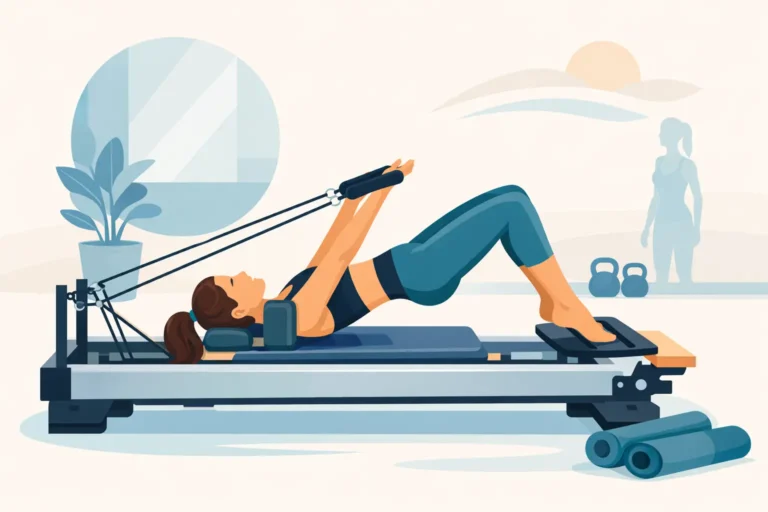
The first noticeable results often don't just appear in the mirror. A body transformation thanks to the reformer can begin with a more relaxed back posture, a more stable stride, or the feeling that your body is finally cooperating instead of aching after a long day at a desk. A slimmer waist and stronger legs are important, but the most lasting change comes from improved movement quality.
Reformer Pilates isn't a workout that promises transformation in a week. It's a precise workout using spring resistance, a moving platform, and your own body. It allows you to exercise deeply, consciously, and without accidentally overloading your joints. Therefore, it's well-suited for both beginners and those who have trained before but want to improve their technique, posture, and body proportions.
How does a reformer change your figure?
Your physique doesn't change with just one ab exercise or hundreds of rushed reps. It's influenced by a combination of muscular strength, pelvic positioning, shoulder blade movement, hip mobility, and daily habits. The reformer helps you work on all of these elements simultaneously.
Springs provide resistance but can also support movement. This makes it easier to feel the correct path of the exercise and activate muscles that usually remain passive as the body compensates with tension in the neck, lower back, or hips. The trainer can precisely adjust the load, tempo, and exercise variation to suit current form.
The visual effect is usually a more upright posture, a visually longer neck, a firmer stomach, lifted buttocks, and a slimmer line of legs and arms. It's not about "sculpting" the body according to a single pattern. It's about building a fit physique that looks good because it moves more confidently and is better organized from the inside.
A strong core without a tense back
Pilates focuses heavily on the core. This doesn't mean constantly tightening the abdominal muscles to their maximum capacity. The goal is to teach the core muscles to work in conjunction with the breath, diaphragm, pelvic floor, and spinal stabilizing muscles.
This is especially important for people who experience lower back tension, have a sedentary job, or feel more neck strain than core strength after abdominal training. On the reformer, you can gradually build control without jerking or having to start with difficult positions on the mat.
Legs and buttocks work to their full potential
The moving platform allows you to train your legs and glutes with different foot and hip positions. However, it's not a simple equivalent of a weightlifting machine. Each movement requires control of the pelvis, knees, and feet, so the muscles work not only harder but also more functionally.
In practice, you'll notice greater stability when walking, climbing stairs, or running. Many people also appreciate the change in the appearance of their lower body: their legs become stronger without feeling heavy, and their buttocks better support proper pelvic positioning.
Better posture changes more than you think
Rounded shoulders, a jutting head, and a sunken chest can make even a slim figure look tired. The reformer trains the muscles between the shoulder blades, thoracic mobility, and shoulder stabilization. This isn't just a cosmetic detail—it's the foundation for more comfortable breathing, safer training, and less neck strain.
Change of attitude can be one of the quickest results to see. Your body doesn't have to change size to look better in clothes. When you stand straighter and your abdomen and pelvis are better supported, your body proportions naturally improve.
The transformation of the silhouette thanks to the reformer requires regularity
Two training sessions a week This is a great starting point for most people. It provides the body with a repetitive stimulus while also providing time for recovery and adaptation. An active person can add a third session or combine the reformer with strength and functional training, walking, or cycling.
The first changes in well-being can be felt after a few sessions. They typically involve movement control, reduced tension, and improved body connection. Visible physique improvements typically take several weeks to several months. The pace depends on your starting point, training frequency, sleep, nutrition, stress level, and activity outside the gym.
It is worth being careful with promises of a quick fix. weight reduction Only thanks to Pilates. The reformer builds strength, improves muscle tone, and increases energy expenditure, but reducing body fat also requires a proper energy balance. If your goal is significant weight loss, the best results come from combining regular classes with daily exercise and a diet that can be maintained for longer than two weeks.
Why does a small group matter?
In precision-based training, details matter. Foot placement, rib position, knee direction, and breathing pattern determine which muscles actually do the work. In a crowded gym, it's easy to miss compensations, especially when you're just learning a movement.
Small groups allow the trainer to continuously improve technique and adjust the springs to the participant's abilities. You don't have to "keep up with everyone." You can work at your own pace, receive a safer version of the exercise, or a more challenging variation when your body is ready.
At Velvet Gym, reformer training can be complemented with mat work, functional training elements, or barre. This is a good option for those who want to combine the precision of Pilates with greater dynamics and variety. The most important thing, however, remains the same: movement should serve your body, not test it at all costs.
Who is a reformer a good choice for?
The reformer is a particularly good choice if you want to improve your physique without relying on jumps, heavy weights, and unintentional fatigue. It's effective for those with a sedentary lifestyle, a weakened core, tight shoulders, reduced mobility, or returning to activity after a break.
It can also be a valuable complement to strength training. A traditional weight training machine is effective in developing maximum strength and allows progression with heavy loads. The reformer, on the other hand, is excellent at teaching control, stabilization, and range-of-motion skills, which are often lacking in standard exercises. These forms don't have to compete with each other—they can mutually enhance each other's effects.
If you have a recent injury, severe pain, have undergone surgery, or have specific medical recommendations, start by consulting a specialist. Training can support your recovery, but it should be tailored to your health, not follow a pre-made plan found online.
How to use training to ensure long-lasting results?
Come regularly, but don't try to make up for weeks off with one intense workout. Make sure you get enough sleep, take a daily walk, and take breaks from sitting. Even the best reformer session won't counteract the dozens of hours spent in one position each day, but it can teach you how to notice tension and respond to it sooner.
It's also a good idea to set a goal that isn't based solely on centimeters. It could be climbing stairs with ease, feeling less uncomfortable during a long car ride, feeling more stable while using a crutch, or feeling more confident in your favorite clothes. These metrics often tell you more about your progress than a single weight reading.
Your physique doesn't need another punishingly restrictive method. It needs movement that's consistent, well-directed, and enjoyable. The reformer gives you the space to build this change slowly—beneficial to your appearance, your spine, and your daily energy.