
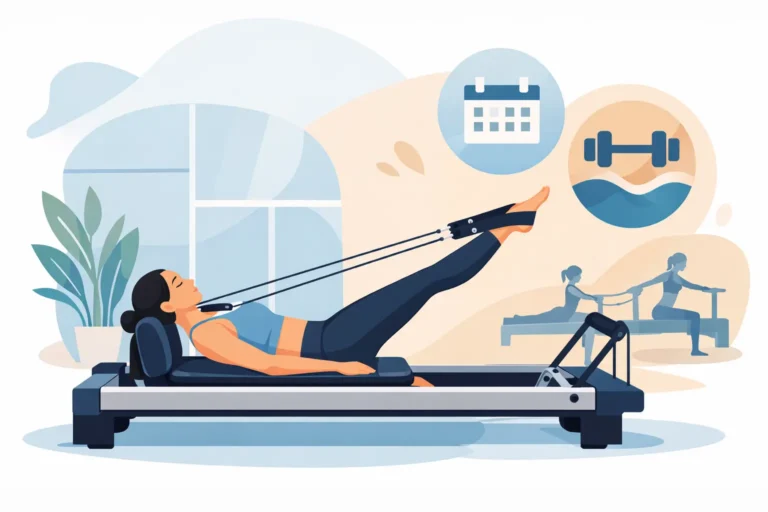
If you search for "how many times a week Pilates reformer," you probably don't want an answer like "it depends," period. You want to know if two workouts are enough or if you need to train four times a week to see a difference in your physique, feel a firmer core, and finally reduce back strain. The good news is that in most cases, you don't have to train every day. You have to train smart.
How many times a week does Pilates reformer give results?
Typically, the best range is 2-3 workouts per week. This frequency allows you to build core strength, improve mobility, teach your body better movement patterns, and simultaneously give yourself time to recover. It's consistency, not a one-time burst, that brings the most visible results.
You can also feel the benefits with just one session per week. Your body begins to align better, tension slowly decreases, and your awareness of movement increases. This rhythm is perfect for beginners, after a longer break, or when Pilates Reformer is a supplement to another activity.
Four workouts per week may make sense for more advanced individuals or those working towards a specific goal, such as improving stability, getting back into shape, or sculpting their physique faster. However, technique and recovery are even more important here. More isn't always better.
Training frequency and your goal
How many times you exercise depends primarily on why you come to the reformer.
If your goal is to reduce back pain, improved posture, and a better daily well-being, two workouts per week are usually sufficient. This frequency provides the body with regular stimulation without overloading the nervous system or muscles. For sedentary jobs, this is often the best starting point.
If you care about a slimmer figure, a stronger core, and more visible visual effects, works well 2-3 times a week. Pilates Reformer strengthens, visually lengthens the body, and improves movement control, but requires consistency. After a few weeks, you'll see the difference not only in the mirror but also in how you stand, walk, and breathe.
If you're returning to exercise after a break, pregnancy, or a period of overexertion, it's worth starting with 1-2 workouts per week. Reaching a high level too quickly often results in muscle tension, fatigue, and a loss of motivation. It's better to build fitness gradually and observe your body's response.
If you already exercise regularly and treat the reformer as a tool to improve the quality of movement, you can train 3 times a week, sometimes even 4. But only if the individual units vary in intensity and are well planned.
How many times a week Pilates Reformer for beginners
For beginners The optimal frequency is usually twice a week. This is enough to learn breathing, pelvic alignment, shoulder blade stabilization, and core muscle activation without chaos or strain. You can also start with one session a week, but progress may be slower because the body needs more time to memorize new patterns.
Beginners often think Pilates Reformer is "light" because the movements are fluid and precise. In practice, it's a demanding workout. Muscles work under tension for extended periods, and precision makes a huge difference. Therefore, at the beginning, less is sometimes more, especially if you want to practice properly and not just "do it" during classes.
It's also good to remember that initial results aren't always visually spectacular. Initially, you'll usually notice improved body control, reduced neck tension, a more stable core, and an easier time maintaining an upright posture. This is a very good sign, as it's on this that lasting change is built.
When once a week is enough and when not
One workout per week makes sense if you're very active or active outside of the gym, and the reformer is intended to complement your routine. It's also a good option if your primary focus is mobility, breathing, tension relief, and strain prevention.
However, this may not be enough if you want to quickly improve core strength, regain fitness after a long break, or truly impact your physique. With one session a week, the body receives a stimulus, but it's harder to maintain consistent movement. Results come, just more slowly.
In practice, many people start with one session per week and then move to two sessions per month. This is a sensible approach. It allows you to become familiar with the equipment, get a feel for the training, and see how your body responds.
Can you do Pilates Reformer 3-4 times a week?
It's possible, but not everyone needs it. This frequency works best when the workouts are varied and guided by attention to technique. One day, the emphasis might be more on core stability and core strength, while another might focus on legs, glutes, mobility, or elements of barre or functional training.
With 3-4 sessions per week, two important questions are important: Are you still exercising precisely? And is your body recovering? If you feel pleasant muscle contraction, improved body alignment, and energy after the session, the plan is likely well-chosen. If you experience chronic fatigue, hip tightness, lower back pain, or a decline in movement quality, it's worth skipping one session.
Pilates Reformer doesn't work best when you do it the most. It works best when the body has a chance to absorb what it's learning.
How to combine the reformer with other workouts
This is important because many people don't want to choose between a slim figure and strength. And rightly so. The reformer combines very well with strength training, walking, cycling, or gentle cardio. You just need to structure your week wisely.
If you have two strength training sessions, Pilates Reformer 1-2 times a week will be great for technique, mobility, and stability. If the reformer is your primary activity, 2-3 sessions a week will be more than enough, and on the other days you can add walking or light recovery activity.
Many people find combining precision training with more functional training very effective. The body then gains not only aesthetically pleasing movement but also real strength for everyday tasks. This is why a model where technology helps control the quality of execution and the trainer can focus on positioning, safety, and adapting the loads to the individual works so well.
How to know if you are training too little or too much
You're not training enough if, after a few weeks, you're still starting from scratch. Your body isn't establishing patterns, you have difficulty maintaining core tension, and any improvement in posture is short-lived. This is a sign that it's worth increasing your regularity.
You're training too much when the quality of your movement declines. You start to "drag" the exercises instead of controlling them, and you develop neck tension, wrist strain, irritation, or just plain fatigue. Pilates isn't about completing sessions. It's about performing each one really well.
A good plan leaves you wanting more, not feeling overwhelmed. After your workout, you should feel your muscles working, your body feeling lighter and more aligned, not chaotic joints and a lack of energy.
Real results and patience
With 2-3 workouts per week, many people notice the first noticeable changes after just 3-4 weeks. Maintaining a straight posture becomes easier, the abdominals begin to work more consciously, and tension in the shoulders and back gradually decreases. More visible visual results usually appear after 8-12 weeks of regular training.
This isn't a method based on shocking the body. It's training that teaches the body to move better. This results in longer-lasting results and a lower risk of overload than with a random, overly intense plan.
If you're looking for a healthy spine, a slimmer physique, and a workout that truly makes a difference, start with a rhythm you can maintain. For most people, this will be twice a week, and then increase the frequency as needed. In a small club setting, with a small group and attentive guidance, such a plan not only delivers results but also provides a level of comfort that helps you stick with your workouts for longer.
The best number of workouts is not the „ideal” one you find on the internet, but the one that your body responds well to and that you can repeat week after week.