
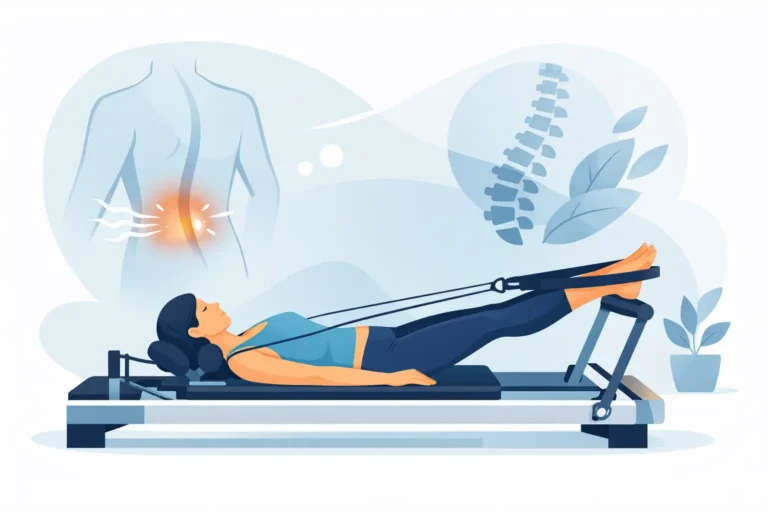
Back pain rarely stems from a single cause. More often, it's the result of a sedentary lifestyle, overexertion, tension, a weakened core, and movements performed haphazardly, day after day. This is precisely why Pilates reformer for back pain is generating so much interest—because it's not based on random strengthening, but on precision, control, and restoring the quality of movement.
This is good news, but with one important caveat: The reformer isn't a magic bullet for every back problem. It can be very helpful if the exercises are properly chosen, technique is followed, and training addresses the real cause of the problem, not just the symptoms.
Pilates reformer for back pain – why is it so effective?
Classic back exercises often fall one of two ways: they're either too light and don't change anything, or too intense and further irritate overloaded structures. The reformer works differently, allowing you to work with spring resistance, but in a controlled and smooth manner.
This is especially important when back pain isn't caused by an injury, but rather by a lack of stability, poor pelvic control, stiff hips, and habitual tension in the lumbar or thoracic spine. In such cases, the body doesn't just need a "stronger back." It needs a better movement pattern.
On the reformer, it's easier to feel how your core works, how to position your ribs, pelvis, and shoulder blades, and how to distribute the load so your back doesn't take all the load. It's this detail that makes the difference. Pain often decreases not because you're exercising more, but because you're finally exercising smarter.
When a reformer really helps
The best results usually occur in people who experience chronic, recurring pain resulting from overuse, sitting, stress, and weakened core muscles. If you feel a tight lower back, a stiff neck, or a "pulling" between your shoulder blades after a long day at your desk, the reformer may be a good option.
It's also effective for those returning to exercise after a long break and who don't want to start with a heavy strength training regimen. The machine's guidance makes it easier to master technique, rebuild mobility, and gradually strengthen the body without unnecessary chaos.
People who have exercised before but still experience back strain despite being active also respond well. This is a common situation. Movement alone isn't always enough. If the body compensates and exercises are performed with poor mechanics, the problem can persist. The reformer helps detect these compensations and correct them immediately.
When to be careful
There are also situations where enthusiasm should be combined with caution. Acute pain, radiating pain to the leg, numbness, recent injury, or post-operative recovery require prior consultation with a specialist. In such cases, training can be a part of recovery, but it shouldn't be the first step without a diagnosis.
The level of training also matters. Pilates reformer works for back pain when:, when the coach is watching on technique, breathing, and body positioning, and not just counting down repetitions. This is especially important for beginners who don't yet feel when they're entering compensation.
Not everyone with back pain responds to the same exercises. For one person, exercises that lengthen and mobilize the thoracic spine will provide relief, while for another, strengthening the glutes and core stabilization will be crucial. Therefore, the best training isn't "trendy," but rather well-adapted.
What does bodywork on the reformer look like?
From the outside, the reformer may look like an elegant machine for a leisurely workout. In practice, it's a highly precise tool. The movable carriage, springs, and various starting positions allow you to relieve certain areas and activate others that are usually dormant.
This is a huge benefit for your back. You can work while lying down, kneeling, sitting, or using supports, and you can adjust the exercise so that the body learns stability without unnecessary compression of the lumbar spine. This isn't just random "leg swinging." It's a workout that prioritizes movement path, range, tempo, and breathing.
In a well-run class, something many people haven't experienced before emerges: body awareness. Suddenly, it becomes clear that a tight back was the result of locked hips, a stiff chest, or a lack of pelvic control. When these elements begin to work together, the spine is no longer forced to constantly play catch-up.
Does the reformer strengthen or loosen up more?
Both, but in the right order and proportion. If your back is painful and tense, the body often doesn't immediately need a stronger stimulus. First, it needs breathing, better alignment, and reducing excessive tension. Only then can you build strength.
This is a significant difference from training, which focuses on intensity from the start. On the reformer, you can work subtly, yet effectively. The core muscles begin to take over, the glutes and abdominal muscles support the spine, and the upper back regains mobility. The result? Less strain and greater comfort in everyday activities.
In practice, many people report not only less pain but also that they find it easier to sit, walk, sleep, and exercise without feeling a "pulling" sensation in the lower back. This is a good sign, as it indicates a real change in pattern, not a temporary relaxation.
Pilates reformer for back pain vs. regular mat
Mat exercises can also be very effective. It's not that the reformer replaces them, but rather that it offers more adjustment options. Springs can aid or hinder movement, and the device's design provides better feedback for the body.
For someone with back pain, this is often a relief. Maintaining proper alignment on the mat is more difficult if you lack strength, mobility, or body awareness. The reformer can speed up this process by allowing you to feel the movement more precisely and safely.
On the other hand, the mat can be a great stepping stone later on – once the body has learned control and can be transferred to simpler conditions. The best approach isn't a "mat vs. equipment" war, but rather choosing what most effectively supports the spine at a given moment.
After how many training sessions can you feel the difference?
It depends on the cause of the pain, your regularity, and what your daily routine outside of the gym looks like. If you exercise once every two weeks and spend the rest of the time sitting for 10 hours a day without any physical hygiene, results will be slower. If you train regularly and simultaneously change a few simple habits, improvement will occur more quickly.
Some people feel lighter after the first session. This is usually a result of reduced pressure and improved breathing. More lasting changes usually come after a few weeks of regular training, when the body begins to automatically adapt to new patterns.
In an intimate work model, with great attention to technology and safety, this process is simply more predictable. That's why at places like Velvet Gym, it's not just the reformer itself that matters, but also the quality of the guidance and the individual adjustment of the loads.
How to Get More Benefits from Your Back from Your Workout
The simple answer is: don't look for heroism. Consistency is better for back pain than bursts. It's better to exercise wisely twice a week than to overdo it once and end up back where you started.
It's also worth sharing your symptoms with your trainer without pretending "it's okay." Does the pain worsen in the morning? After sitting? When bending over? Does it radiate? Details like these really help you choose your exercises. A good workout doesn't start with an ambitious plan, but with accurate observation.
Outside the gym, simple things matter: changing your position more often, moving a few minutes a day, breathing calmly, and getting enough sleep. The reformer can provide a great boost, but the body still needs the right conditions to sustain that change.
If your back has been sending you signals for a long time, don't treat it as something that will "go away on its own." Sometimes relief begins with one well-conducted training and from the decision that this time you don't just want to exercise, but really teach your body to move better.