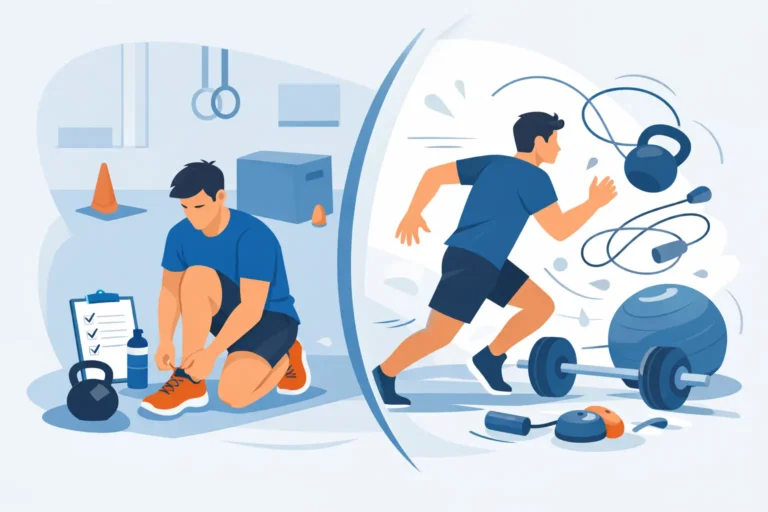
The first mistake usually seems innocent. Someone searches for "how to start functional training," watches a few dynamic videos, and immediately tries jump squats, burpees, and single-leg exercises. The problem is, functional training doesn't start with tempo. It starts with movement quality, stabilization, and adapting to the body you have today—not the one you want in three months.
This is good news because you don't have to be "fit" to get started. You also don't need complicated equipment or gym experience. You just need a plan that strengthens your entire body, improves movement control, and doesn't put unnecessary strain on your back, shoulders, or knees.
How to start functional training if you're just getting back into exercise
Functional training makes sense when it translates into everyday life. It helps you bend better, lift groceries, climb stairs, maintain a stable posture at your desk, and feel more confident in your body. It's not just a "power workout." It's training that teaches your body to work more efficiently.
If you're returning to exercise after a long break, start with an honest assessment of your starting point. Does your back hurt after sitting? Do you lack strength in your legs? Do you get out of breath easily? Do you struggle with coordination? The answers are more important than the number of calories burned in your first class.
A simple goal works best initially: improve movement patterns and build a foundation. In practice, this means learning the fundamentals, such as proper squatting, safe hip flexion, core stabilization, shoulder blade control, and balance. These elements will ultimately determine physique, strength, and comfort.
How to start functional training in practice
It's best to start with two or three workouts per week. This frequency allows the body to adapt without overtraining and allows for recovery. With greater enthusiasm, it's easy to overdo it, and then, instead of consistency, you'll experience pain, stiffness, and a loss of motivation.
The first few weeks shouldn't be too intense. It's better to do fewer exercises, but thoroughly. A good opening is a full-body workout based on a few simple movements: squats, hip thrusts, pulls, pushes, anti-rotation, and balance exercises. It sounds technical, but it's all about practicality – the legs should work in conjunction with the glutes, the abdominals should stabilize, and the shoulders shouldn't take up all the work.
Bodyweight exercises, such as light dumbbells, resistance bands, or a light kettlebell, are great at first. Not because they're "easy," but because they help you learn control. Only once the movement is stable should you increase the tempo, range, or load.
What not to do at the start
The most common mistake is copying a more advanced person's routine. Just because an exercise looks impressive doesn't mean it will be effective at your level. In functional training, it's easy to confuse intensity with quality. A sweaty forehead doesn't always indicate a good workout.
The second mistake is skipping a warm-up. If your hips are stiff and your thoracic spine is barely moving, your body will "find" range anyway—usually where it shouldn't. This is where you can overload your lower back, neck, or knees.
The third problem is adding jumps, dynamic movements, and unstable positions too quickly. Such elements make sense, but only if you can maintain control in simpler versions. For one person, a safe start might be a weighted walk and a leisurely box squat. For another, single-leg exercises and more athletic work. This really depends on your movement history, mobility, and goal.
What should the foreground look like?
A good plan for a beginner doesn't have to be complex. It should be clear and repeatable. The body likes clear signals. If you do completely different things every workout, it's harder to notice progress and improve technique.
In practice, a single workout might consist of a short mobilization, an activation section, and a main block. First, you prepare your joints and breathing, then "wake up" your glutes, abs, and shoulders, and finally, perform some basic strength and functional exercises. For example, a squat, a simplified deadlift, a row, a bench press or pulldown, and a stabilization exercise.
It doesn't have to be long. For many people, 40-50 minutes of work is perfectly sufficient if the training is well-conducted. Especially at the beginning, consistency is key, not record-breaking times in the gym.
How many sets and repetitions to start with?
If you're just starting out, 2-3 sets of 8-12 reps at an easy pace usually works well. Don't work yourself to the point of exhaustion. Leave yourself some leeway. This makes it easier to maintain your technique and return to the next workout without getting discouraged.
In stabilization exercises, precision is often better than breaking records. A shorter, well-positioned plank often yields more results than prolonged, fatigue-inducing hangs and aggravating overload.
Equipment is important, but not the most important thing
Many people put off starting because they believe they can't exercise effectively without a full gym. This is a myth. You can get off to a very effective start even with simple tools, as long as the plan includes basic movement patterns and progression.
At the same time, it's worth being honest: equipment and training method can make a big difference. Especially if you're a beginner, have a sedentary job, are recovering from back pain, or simply want to exercise without the guesswork. Modern solutions, such as visual guidance of exercises and current technique control, help you understand the movement faster and select the load more safely. That's why, in small clubs like Velvet Gym, the combination of technology and attentive trainer support works so well.
How to know if a plan is working
The effects of functional training aren't always visible in the mirror first. Often, they're felt in everyday life. You'll get up from a chair more easily, feel less tension in your neck, stairs won't be so tiring, and after a long day at the computer, your back won't feel as "cracked.".
Only then do improvements in strength, endurance, and physique come. This is important because many people give up too early, expecting an immediate change in appearance. However, the body first builds control and stability, and only then reveals this externally.
Another good sign of progress is when the exercises become smoother. You're no longer struggling with balance with every movement, your breathing is coordinating better with your abdominal contraction, and your range of motion is improving without pain. This is the moment when you can think about the next step.
When to increase the difficulty
Not when the exercise becomes boring. Only when you perform it stably and without compensating. If your knees fall inward during a squat, and your lower back immediately takes over when you lift the weight, adding weight won't accelerate your results. It will likely stall your progress.
Increasing difficulty can mean different things. Sometimes it's a heavier weight, sometimes a slower pace, longer time under tension, or a transition to a single-leg variation. Sometimes it's simply shortening the rest periods. The best progression is one that develops the body, not tests its random resistance.
Is functional training suitable for everyone?
In most cases, yes, but the form must be adjusted. Someone recovering from a long break, a senior, someone recovering from an injury, and someone training to improve their fitness can all benefit from the same approach, but not the same exercises in the same version.
If you suffer from back pain, knee problems, shoulder limitations, or are recovering from an injury, personalized guidance and careful observation of technique are especially important. Functional training can be very helpful, but poorly tailored training can also sustain unnecessary overload. It's not about being cautious, but about making a smart choice.
How to maintain regularity
The best plan is the one you actually stick to. If you commit to five workouts a week even though you haven't exercised in months, your motivation will quickly clash with your schedule and fatigue. Two well-planned sessions a week are worth more than an ambitious schedule that's impossible to maintain.
Choosing a place where you don't feel pressured or chaotic also helps. For many people, a private space, clear instructions, and a workout where someone truly looks at the quality of their movement make a huge difference. This is especially important when the goal isn't just physique, but also healthy spine, better posture and everyday fitness.
Don't try to prove anything to your body at the start. Treat training as a process of learning movement, not a test of endurance. When you give yourself a few weeks to ease into it, the results come faster than you might think—and, more importantly, they last longer.