
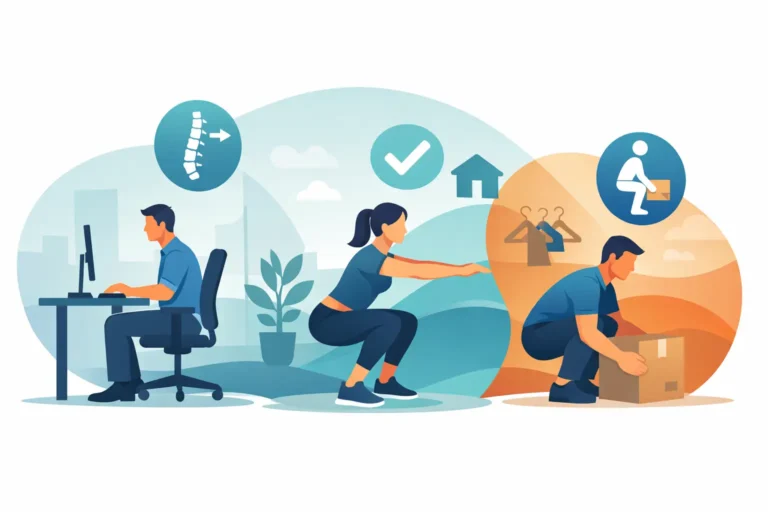
The first sign that something isn't working in your workout usually doesn't show up on the scale. It shows up in the mirror, in your shoulders tightening after a set of presses, in your lower back "calling up" after a squat, or in your knees, which were supposed to be working but ended up taking the brunt of the load again. If you're wondering how to exercise with proper form, start with one simple thought: good exercise isn't just about looking impressive. It needs to be safe, purposeful, and tailored to your body.
This is important because technique isn't just an afterthought for advanced users. It's fundamental for everyone – even beginners, those returning after a break, or those practicing."„for a healthy back” and not for athletic performance. A well-executed movement allows for better muscle activation, reduces overload, and produces faster, more predictable results.
How to exercise with correct technique, not just intensity
Many people train honestly, regularly, and with dedication—yet they don't see the results they expect. The problem is often not a lack of motivation, but rather a lack of movement control. The body will always find a way to get the job done. The question is whether it will do so with the right muscles and in a safe position.
For example? It's very easy to "escape" into the lumbar region when doing glute exercises. Planks often work the neck and shoulders more than the core. Some people go low when doing squats, but they lose foot and pelvic stability. From the outside, the movement can be similar. Inside, the difference is huge.
Therefore, technique isn't a rigid, "picture-perfect" form, but rather a quality of movement tailored to the individual. Limb length, joint mobility, previous injuries, strength level, and daily habits truly matter. What may be a neutral position for one person may be a compensatory one for another.
Where to start if you want to exercise well
The best start is less dramatic than it often seems. Not with heavy weight, not at a fast pace, and not with "burn to failure." It starts with body positioning and understanding what exactly needs to be working.
In practice, it's worth paying attention to three things: breathing, starting position, and movement path. Breathing helps stabilize the core and maintain control. The starting position positions the joints within a safe range. Movement path shows whether the exercise is leading you where it should be, or whether the body is starting to struggle.
This is why movement quality-based workouts such as Pilates Reformer or well-executed functional exercises teach more than just "doing sets." They teach you how to feel your body. And when you start to feel which muscles are working and where you're losing control, improvement comes faster.
The setting matters more than the number of repetitions
Ten reps performed correctly yield more than thirty performed haphazardly. This isn't a slogan, it's mechanics. If the shoulder is positioned incorrectly, each subsequent repetition reinforces the poor pattern. If the pelvis shifts, the body learns to compensate, not to perform correctly.
Good technique often means a smaller range of motion at first. And that's okay. If you're losing your neutral spine alignment when squatting, a shallower movement is a better choice than an ambitious "lower at all costs" approach. Range builds gradually, along with mobility and strength.
The pace of the exercise is also part of the technique.
The faster you practice, the easier it is to hide mistakes. Momentum masks a lack of control, but it doesn't solve the problem. A slower pace allows you to see if your knee is stable, if your ribs are not falling forward, and if your abs are actually working.
This doesn't mean that every workout should be very gentle. Intensity is necessary. However, the body must first be able to perform the movement well, and only then quickly, for a longer period, or with a heavier load.
The most common mistakes that ruin your technique
Mistakes rarely stem from a lack of willpower. More often, they stem from rushing, lifting too much weight, or copying exercises that aren't tailored to your own abilities. Many people start with a version their body isn't yet ready for.
A common problem is a lack of core stability. When the core isn't working well enough, tension transfers to places it shouldn't – the neck, shoulders, or lower back. Another mistake is ignoring the feet. The feet form the foundation for squats, lunges, and many standing exercises. If the foot "sinks" inward, the upper body usually follows suit.
The third issue is the training ego. Too much weight causes the body to focus on surviving the movement rather than on its quality. The result? Less work in the target muscles, more overload, and slower progress. Sometimes a step back is the fastest way forward.
How to check if you are exercising with the correct technique
The simplest answer is: don't judge a movement solely on fatigue. Just because it "burns" doesn't mean the exercise is done well. A better question is whether you feel the work is where it should be, and whether your body feels stronger after the workout, not sloppily put together.
Recording a short video, practicing in front of a mirror, or getting feedback from a trainer can all help. This is also playing an increasingly important role. motion imaging technology, because it allows you to notice things that the exerciser might not notice on their own – for example, asymmetry, too fast a pace, or loss of axis of motion. This is especially valuable when you want to train effectively, but without guesswork.
Signs that your technique needs improvement
If pain recurs regularly in the same spot, it's not the "normal price of training." If you always feel a certain exercise in your joints instead of your muscles, it's worth stopping and checking your setup. The same applies if, after several weeks of training, you don't see any improvement in your strength, stability, or posture despite regularity.
It's also worth paying attention to your breathing. Holding your breath with every movement, tensing your jaw, or lifting your shoulders is often a sign that your body isn't comfortable with a given pattern.
Does technology always look the same?
No. And that's the good news. Correct technique doesn't mean everyone has to move identically. There are common principles—stabilization, control, safe joint positioning—but the details vary from person to person.
Someone with a sedentary job may need more mobilization preparation before training their legs. Someone with excessive shoulder tension will benefit from a different hand position than someone who is very mobile. A senior will work on the same pattern, but at a slower pace and with more support. This is still a good technique, but it's just a well-chosen one.
Therefore, quality training isn't about copying. It's about observation and correction. This is where exercise begins to benefit your health, figure, and fitness all at once.
How to practice correct technique in practice
A step-by-step approach works best. First, learn the starting position. Then perform a few reps slowly, without rushing. Only then should you add weight, range, or tempo. This may sound less exciting than intense training from the very first minute, but it yields much better results after a month, three months, and even six months.
Small groups and training sessions with ongoing corrections also work well in practice. This allows the trainer to see more than just the number of repetitions. They can correct pelvic positioning, remind you to breathe, reduce the weight, or change the exercise variation to a more appropriate one. At Velvet Gym, it's the combination of the trainer's work and visual guidance that provides a significant advantage for those who want to train more precisely and without chaos.
If you're training alone, choose fewer exercises, but perform them consciously. It's better to do a short, well-controlled set than a long, unfocused routine.
Technology is a faster way to results
Good technique doesn't slow down progress. It organizes it. It helps you build strength, improve your posture, slim your figure, and reduce stress on your spine. Equally important, it allows you to train regularly, reducing the risk of overexertion, which so often derails a promising plan.
You don't have to be perfect from the very first workout. You just need to start paying attention to the quality of your movement instead of just the pace and calorie count. Your body quickly shows when it's working in better conditions – it becomes more stable, stronger, and simply feels better. This is a good place to start every workout.