
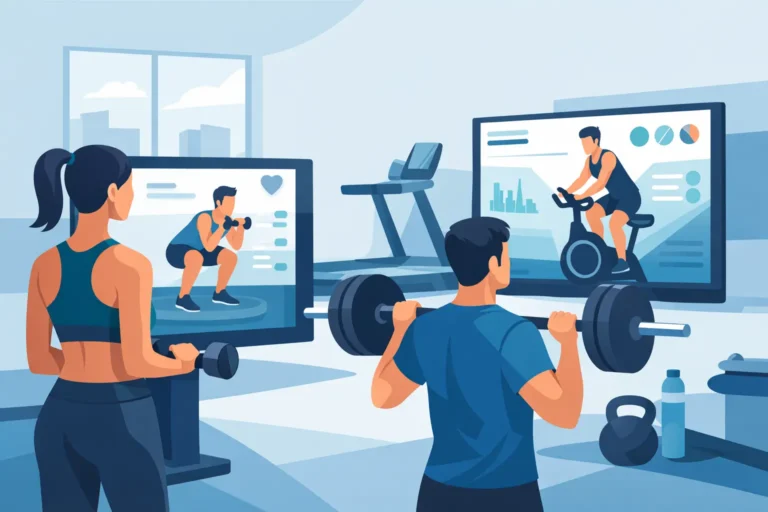
The first 10 minutes at the gym can often determine whether you'll return tomorrow or take a month off. If you don't know where to start, how to set up an exercise, or whether you're doing it correctly, motivation quickly wanes. That's why a gym with workout screens is changing the way many people approach exercise—from chaos and guesswork to greater certainty, control, and a concrete plan.
This solution is particularly effective for those who want to exercise effectively but don't want to randomly wander between crowded machines. The screen doesn't replace a trainer, but rather organizes the process. It shows the exercises, the pace, the technique, and the structure of the entire training session. This makes it easier to focus on the quality of movement rather than wondering what to do next.
How the Gym Works with Workout Screens
In practice, the idea is that training is guided visually. Instead of having to create a plan yourself or nervously glance at your phone, you have clear instructions right in front of you. You can see the exercise, the number of repetitions or the duration of the workout, and often also how to position your body and move on to the next stage.
It's a seemingly small change, but it makes a huge difference. Training becomes more fluid, and the body receives a consistent stimulus. There are fewer accidental interruptions, less chaos, and fewer mistakes resulting from rushing. This is a huge relief for beginners, and for more advanced users, a convenient way to maintain the quality and pace of their work.
In modern clubs, screens are part of a larger system that supports strength and functional training. It's not just about showing an exercise video. It's about combining planning, movement control, and better session organization. With a trainer working alongside, they can focus on what matters most: technique, safety, and individualized load adjustments.
Why this training model gives you a better sense of control
Many people at the traditional gym exercise with uncertainty. They know they "have to do something," but they don't always know what, how much, or why. This is one reason results come more slowly, or sometimes not at all.
A gym with training screens provides a more structured experience. Each step of the workout is clear, making it easier to stay focused. You don't waste energy searching for inspiration. You can focus your full attention on breathing, pelvic positioning, shoulder blade movement, and core stabilization. And these are the elements that determine whether an exercise is truly effective.
For many people, psychological comfort is also important. Not everyone likes to ask questions, watch, spy on others, and wonder if they're performing the movement correctly. Visual guidance allows for greater independence without feeling lost. This is especially valuable when returning to activity after a break, having a sedentary job, or wanting to safely strengthen your body without overloading the spine.
Screens help, but technology still wins
It's worth stating this bluntly: technology alone doesn't produce results. The screen is a tool, not a goal. Its advantage lies in structuring training and facilitating proper execution, but true progress still depends on the quality of movement, regularity, and sensibly selected loads.
That's why the best results are achieved when visuals are combined with human feedback. When an exercise is displayed clearly and precisely, the trainer doesn't have to waste time explaining the basics to each person from scratch. Instead, they can more quickly identify compensations, improve positioning, and adjust the difficulty level. In practice, this translates into safer training and fewer mistakes being repeated.
This is especially important when the goal isn't just to "burn calories," but to improve your figure, strengthen your core, relieve back strain, and build fitness that's useful in everyday life. Aesthetics then go hand in hand with health, not at the expense of it.
Who will find a gym with training screens the best choice?
People who want to be guided but also value independence benefit the most. If you need structure and like to know what you're doing and why, this model simply simplifies training.
Beginners thrive here. Instead of the stress of a first-time visit to a club, they experience a clear process and a lower barrier to entry. They don't have to improvise. They can focus on their bodies and gradually build confidence in movement.
It's also a great solution for those returning from a break, a period of overwork, or struggling with stress resulting from a sedentary lifestyle. In such cases, it's not just about what to do, but how to do it. Clear instructions and a more relaxed pace help you better control your technique.
On the other hand, even regular exercisers can appreciate such a system. Not because they're unfamiliar with the exercises, but because they want to train more efficiently and consciously. A well-designed on-screen workout reduces downtime, maintains rhythm, and organizes the session without sacrificing quality.
When this model may not be perfect
There are also situations where visual guidance alone isn't enough. If you have a recent injury, significant mobility limitations, or a very specific athletic goal, you need even more individualization. In these cases, the support of a personal trainer and a thorough analysis of movement patterns become crucial.
Not everyone is comfortable with the pace dictated by the system. Some prefer a very free-form workout, with no structure or set order. However, if you're looking for results, this argument often proves false. Too much freedom can be convenient, but it's rarely effective.
It's also important to distinguish a well-designed gym with training screens from one that uses technology merely as a gimmick. A screen alone doesn't guarantee quality. What matters is whether the entire training model is built around safety, a meaningful program, and genuine care for the exerciser.
What do you gain beyond the training itself?
The most noticeable benefit is consistency. When training has a clear structure, it's easier to exercise regularly. And consistency is often the element most lacking for people who are busy, tired, and trying to squeeze in activity between their responsibilities.
The second benefit is greater precision of movement. This translates not only to better muscle feeling and posture, but also to everyday comfort. Less tension in the neck, better posture, a stronger core and greater freedom of movement are effects that can really be felt outside the club.
The third factor is comfort. The intimate environment, small groups, and clearly guided training are simply less overwhelming than an anonymous, noisy gym. For many people, this isn't a detail, but a prerequisite for long-term exercise. That's why, in places like Velvet Gym, technology doesn't isolate people but creates better conditions for more intelligent body work.
How to Choose a Good Gym with Workout Screens
Before signing up for a membership, check not only the equipment but also the entire training process. A good gym with training screens should provide clarity, not additional confusion. Screens are meant to support movement, not distract.
Pay attention to whether the exercises are logically arranged, whether someone focuses on technique, and whether the difficulty level can be adjusted to your fitness level. If a club prioritizes quality, you'll see it immediately – in the organization of the space, the way classes are conducted, and how they talk about the results. Not only about burning calories, but also about spinal health, fitness, strength, and comfort.
For residents of Józefów, Otwock, Falenica, and Karczew, this has an added practical dimension. If a club is close by and operates at hours that realistically fit their lives, it's easier to maintain a rhythm. And the best workout isn't the most impressive one on paper, but the one you actually return to.
A modern gym doesn't have to be loud, chaotic, or based on the "do it yourself" principle. A model that increasingly wins is one in which technology organizes training while humans give it meaning. If you want to exercise effectively, safely, and with greater confidence, this is a very good direction – especially if you want not only to change your physique but also to make your body feel better.