
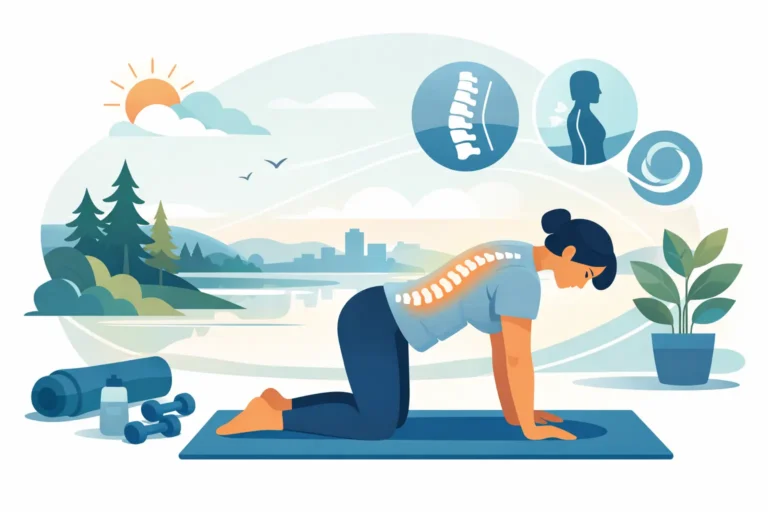
Pain between the shoulder blades after hours at the computer, a stiff neck after driving, a stiff lower back after getting out of bed in the morning – these aren't usually signs that you need to exercise harder. More often, they mean you need to exercise smarter. That's why spine health exercises in Józefów are becoming increasingly popular among people who want to not only relieve discomfort but also improve the quality of their daily movement.
When your spine needs support
Spinal pain rarely occurs without a cause. For some, the problem is a sedentary lifestyle, for others, a lack of core strength, post-workout strain, or stress-related tension. Sometimes the pain appears only at the end of the day, and sometimes immediately after bending down to do some shopping or after a long walk.
This is important because not all discomfort is the same. One person needs greater thoracic mobility, another needs pelvic stabilization and core strengthening, and yet another needs to learn proper breathing patterns. Therefore, effective exercises don't rely on a random set of movements from the internet, but on matching the exercises to the body's actual needs.
Exercises for a healthy spine Józefów – what really works
The best forms of movement are those that combine three elements: strengthening, improving movement control, and gradually increasing range of motion without overloading the joints. Stretching alone provides temporary relief, but if the body lacks stability, the tension usually returns. On the other hand, excessively intense strength training, performed without proper technique, can exacerbate the problem.
Good practice looks different. First, you teach the body to maintain a neutral alignment, work with breathing, and activate the muscles that support the spine. Only then do you add more challenging elements: resistance, a wider range of motion, more challenging positions, and functional loads. This approach yields results because, instead of merely combating pain, it improves the way the body functions every day.
Stabilization instead of random reinforcement
People with back pain often hear that they need to "strengthen their abs." This is true, but only partially. It's not about intense contractions and fast sets, but about working the core muscles that stabilize the torso, pelvis, and lumbar spine. Without this, even simple bending or standing up from a chair can involve unnecessary strain.
In practice, exercises that teach control of the body's core, the alignment of the ribs, pelvis, and shoulder blades, are effective. These are less visually impressive than traditional fitness training, but it's this precision that makes the biggest difference in a healthy spine.
Mobility where you need it
The spine doesn't like stiffness or excessive, uncontrolled mobility. Therefore, exercises should improve mobility where it's lacking, not "stretch everything." Very often, a tight cervical or lumbar spine is the result of weaker thoracic, hip, or shoulder girdle function.
This is why a well-conducted workout doesn't focus solely on the point of pain. If your lower back is strained, you need to examine how your glutes, hips, and abdominals are working. If your neck is constantly tense, it's worth examining your shoulder blades, chest, and breathing.
Why technique matters more than repetitions
When it comes to the spine, quality always trumps quantity. Ten precise repetitions yield more than thirty rushed ones. This is especially important for beginners, those who have taken a break from exercise, or those returning to exercise after a period of pain.
A well-executed workout allows you to immediately spot compensations—moments when the body "cheat" to perform a task more easily. For example, the shoulders take over the work of the torso, the lower back arches instead of stabilizing, and the neck tenses instead of remaining elongated. These subtle details determine whether an exercise is helpful or just looks good.
This is where the connection provides a huge advantage trainer's work with modern movement guidance. At Velvet Gym, exercisers are supported not only by guidance but also by clear exercise visualization, making it easier to maintain technique and safely adjust the level of difficulty.
Pilates Reformer and a healthy spine
If your goal is back relief, better posture, and a slimmer, stronger physique, Pilates Reformer is one of the most sensible paths. Not because it's trendy, but because it allows you to exercise with control, fluidity, and appropriate resistance. The equipment supports movement, but also places demands on where the body needs activation.
This is a huge benefit for the spine. You can work on stabilization without overloading, improve mobility without aggressive stretching, and build strength without immediately jumping into a heavy workout. For many people, this type of movement helps them get back into a regular routine, as their body feels better after a workout, not more "wracked.".
This doesn't mean that Reformer is the solution for everyone in every situation. sharp pain, recent injuries, or specific medical recommendations, training always needs to be tailored individually. However, as a tool for improving movement quality and preventing overuse, it works very well.
Functional training can also support the spine
Many people assume that a healthy spine means only gentle exercise. However, properly conducted strength and functional training can also be health-promoting. There's one condition: technique, control, and proper load must take precedence over pace and ambition.
This makes sense especially if you're looking not only to reduce back pain but also to feel more powerful in your daily life. Carrying groceries, climbing stairs, lifting a child, gardening, or taking a long walk all require a strong core, not just flexibility. The spine appreciates strong, cohesive muscles surrounding it.
Therefore, a sensible plan often combines elements of stability, mobility, and strength. Not all at once, and not from the very first workout, but in a logical sequence.
Exercises for a healthy spine in Józefów – who is it a good choice for?
This type of training is effective for those with sedentary jobs, those who have been away from physical activity for a long time, those who have experienced periodic back pain, and those who exercise regularly but feel their body no longer works as freely as it once did. It's also a great option for women who want to improve their posture, slim their figure, and relieve pressure on the lumbar and cervical spine.
It's worth remembering, however, that a "healthy spine" doesn't mean a one-size-fits-all program. A senior will need a different pace and range of motion than someone in their thirties who wants to combine pain prevention with getting in shape. Someone who has just given birth may need to rebuild their stability and work on their breathing, while someone who is active in sports may need to improve their movement patterns and improve control during physical exertion.
How to start to help yourself, not harm yourself
It's best to start by assessing how the body is working now, rather than what it "should" be doing. If the pain is acute, radiating, numbness is present, or the problem has been ongoing for a long time, it's best to first consult a health professional. Training is meant to support, not replace, diagnostics where needed.
If your symptoms are primarily related to tension, weakness, and overload, well-chosen exercises can make a big difference after just a few weeks. Typically, the initial effect isn't a dramatic change in your posture, but something more practical: sitting up straighter more easily, standing up without stiffness, breathing more freely, and feeling less tense at the end of the day.
The best results come from consistency. Two well-developed workouts a week are more valuable than one intense burst of exercise every now and then. The spine appreciates predictability, gradual progression, and precise movement.
What to pay attention to when choosing classes
If you're looking for a place to exercise for a healthy spine in Józefów, look beyond the name of the class. It's important to consider whether the training is conducted in a small group, whether the trainer corrects technique, whether the difficulty level can be adjusted, and whether the program actually promotes quality movement rather than just fatigue.
The atmosphere is also crucial. It's difficult to progress when working with pain and tension, rushing through noise, and feeling like you have to keep up with everyone. A cozy environment, clear guidance, and a sense of security help the body function better.
A healthy spine doesn't require heroic training. It requires regular, intelligent movement that teaches the body stability, lightness, and strength where it's truly needed. And when exercises are well-chosen, the back ceases to be a limitation and once again becomes a support in everyday life.