
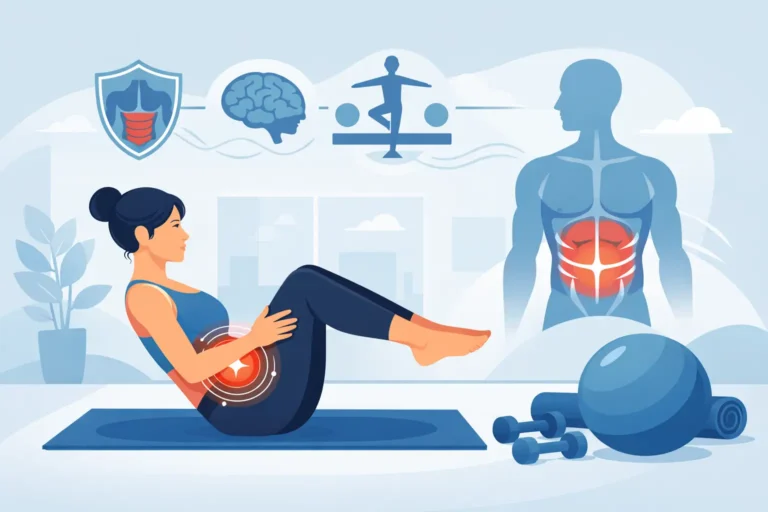
If you feel tension in your lower back after a long day of sitting, and your shoulders, pelvis, or abs quickly give out during training, the problem often isn't a lack of strength. It's likely that you need core training—working on stabilization, movement control, and conscious use of your body, rather than forcing yourself to perform more reps.
What exactly are the deep muscles?
The core muscles are not just one muscle group, but an entire system responsible for stabilizing the trunk and joints. These muscles most often include the transverse abdominis, pelvic floor muscles, diaphragm, and deep paraspinal muscles. These muscles help maintain a neutral spine, control the pelvis, and transfer power between the upper and lower body.
In practice, it's not about "squeezing your abs" throughout the entire workout. It's about being able to engage the right structures at the right moment. Therefore, someone who does heavy squats or runs regularly doesn't necessarily have good stability. You can be fit and yet lose control of basic movement patterns.
Why does core muscle training give such noticeable results?
The biggest benefit isn't always immediately apparent in the mirror. Often, the first thing that comes to mind is a better sense of your body. Maintaining a straighter posture becomes easier, neck tension decreases, movement becomes smoother, and strength and functional exercises become much more technically effective.
A well-executed core workout can support those who want to improve their posture, return to exercise after a long break, take care of their spine, or simply exercise more mindfully. It's also a great foundation for those who want to shape their physique. When the core is stable, it's easier to engage the glutes, legs, and back without overloading the lumbar spine.
It's worth adding the important "it depends" here. If back pain is acute, radiating, or recurring, exercise alone shouldn't replace diagnosis. Exercises often help, but only if they are well-chosen and performed without provoking symptoms.
How to recognize when your core muscles need attention
Not everyone immediately realizes they have a stabilization problem. It's more often visible through indirect symptoms. A protruding abdomen during exercise, ribs that rise, a strained lower back when lifting legs, unsteadiness in support, or tense shoulders during simple arm movements—these are common signs that the body is seeking compensation.
A similar situation occurs with people who exercise regularly but still don't see any improvement in their movement quality. If, after a workout, you feel more pain in your neck than in your stomach, and you struggle to maintain balance and breathe calmly in simple positions, it's worth going back to the basics. This is where real change begins.
What is effective training for deep muscles?
Effectiveness doesn't come from exotic exercises. Precision, breathing, and gradual difficulty are key. Core muscles respond best to exercises that require the body to stabilize in a controlled manner, rather than to random abdominal "burning.".
That's why exercises performed at a slower pace, with pauses, and controlled rib, pelvic, and shoulder blade positions work so well. Sometimes, maintaining a calm, lying or kneeling position can be more demanding than a dynamic series of popular crunches. This is normal. In this type of training, quality always trumps pace.
Breathing is not an addition, it is the basis
The diaphragm works with the deep muscles constantly. If you breathe shallowly and high, your body is more likely to build tension where it shouldn't – in your neck, shoulders, and chest. When you learn to breathe calmly, guided by your breathing and maintain a stable core, your body begins to work more efficiently.
That is why in health-promoting training and methods such as like Pilates So much emphasis is placed on connecting breath with movement. Not for the sake of wellness, but because without it, it's difficult to develop true control.
Less is more
The most common mistake is moving too quickly to difficult exercises. Planks, dynamic leg raises, and unstable surfaces look impressive, but they're not always a good start. If the body can't stabilize basic positions, a more difficult version usually only reinforces the bad pattern.
A short, mindful workout yields better results than a long, unsupervised set. Sometimes 20-30 minutes of well-executed work can yield more than an hour of "pass-the-draw" training.
What forms of exercise best support the core muscles?
There's no single correct path, but there are methods that are particularly effective at developing stabilization. Pilates produces excellent results, especially when the instructor pays attention to body positioning, breathing, and precision. It's a form that teaches control without excessive joint strain and provides excellent support. healthy spine.
Functional training can be equally effective, as long as it doesn't devolve into a chaotic timed circuit. When exercises are tailored to the user's level and a trainer monitors technique, you can simultaneously build strength and strengthen your core. This is especially important for those who want to not only relieve tension but also improve their form, physique, and daily fitness.
In practice, a combination of both approaches works best. Precision and control on the one hand, strength and functionality on the other. This approach produces the most lasting results, because the body not only "knows how to adjust" but also can maintain this quality of movement under greater load.
Core muscle training for a flat stomach and better posture
This is a topic that comes up again and again. Does core training give you a flat stomach? Yes, but it's not a quick fix. Strengthening the transverse abdominis can improve abdominal tone, influence pelvic alignment, and give you a slimmer figure. However, it won't replace a comprehensive plan that includes activity, recovery, and nutrition.
However, it often results in something more noticeable than inches around the waist – improved posture. When the ribs stop "slumping," the shoulders stop sagging forward, and the pelvis is more stable, the body looks lighter and more proportionate. It's not a matter of posing, but of a real change in movement patterns.
Who will benefit from this type of training?
For those with sedentary jobs, those returning to regular exercise after a break, and anyone who feels they want to train smarter, not just harder. It's also a great choice for women who want to stay fit. slim figure, better flexibility and back relief.
It's also suitable for active individuals who already do strength training, running, or cycling. Core muscles aren't a substitute for other forms of training. They enhance their quality. They make it easier to maintain technique, reduce overload, and better utilize strength during movement.
How to get started and really feel the difference
Initially, it's best to focus on leading. Self-paced online training can be helpful, but only if you already know how to position your pelvis, breathing, and ribs. Without this, it's easy to confuse tension with activation, perpetuating errors that are difficult to correct later.
A good start is to calmly assess the quality of movement and select exercises appropriate to your level. One person may need to learn to breathe and stabilize in simple positions. Another may immediately begin working more functionally, with a greater range and load. In modern gyms like Velvet Gym, combining a trainer with visual guidance is a major advantage, as it's easier to see technique and more quickly identify where improvement is needed.
It's also worth giving yourself some time. Core muscles don't build results by accident. They require consistency and patience. Two or three quality sessions a week usually yield better results than a burst of activity every now and then.
What not to expect from your first training sessions
You won't always experience classic "soreness." Sometimes the first effect will be a feeling that the exercises were surprisingly challenging despite the low intensity. You may also notice a greater awareness of your body position throughout the day, less tension in the lumbar spine, or an easier time maintaining a straight posture.
That's a good sign. Core training often works from the inside out, before it shows on the outside. And when the foundation begins to work better, the entire body reaches a higher level—without chaos, without overload, and without guessing whether you're really doing the right thing.
If you want to feel more confident in your body, move more easily, and simultaneously take care of your abs, back, and posture, start not with the most difficult plan, but with the best movement pattern. This is where lasting results begin.