
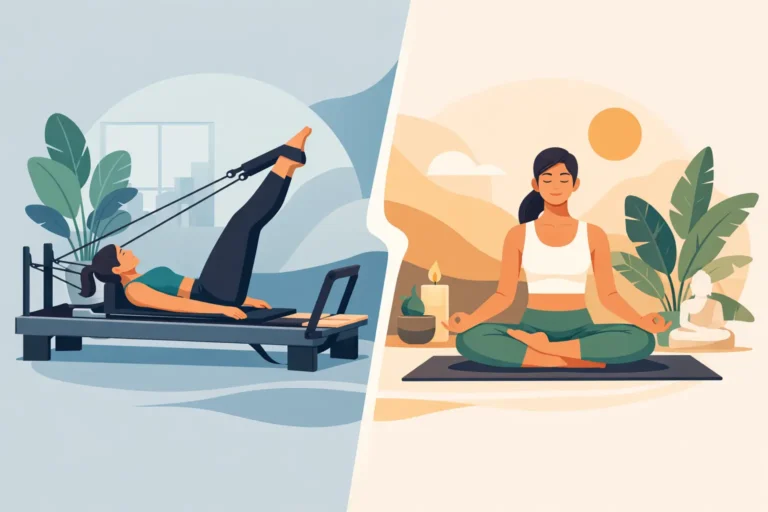
If you're faced with the choice between Pilates reformer and yoga, you're probably not looking for a trendy trend, but rather a workout that will truly make a difference. Less back pain, better posture, a slimmer physique, and greater movement control—these are specific goals. And that's why it's worth comparing these two forms without oversimplification.
Both methods make sense. Both can improve mobility, breathing, focus, and overall fitness. The difference begins when you ask about results, rate of progression, level of spinal support, and how well the training adapts to your actual body, not to some ideal image you might have seen online.
Pilates reformer or yoga – the shortest answer
If you're primarily interested in stretching, calming down, and working your body through static poses or flowing sequences, yoga is a great choice. However, if you're looking to simultaneously strengthen your core, improve your posture, build stability, and work in a more precise, controlled manner, reformer Pilates typically yields faster and more measurable results.
This doesn't mean one is better for everyone. It just means that each tool works a little differently. And the right question isn't: which is more popular? It's more important to ask: what will help my body here and now?
What is the real difference between yoga and Pilates reformer?
Yoga is based on asana, breathing, and body awareness. Depending on the style, it can be calming and restorative or more intense and dynamic. For many people, it combines movement and mental resetting, which is in itself a tremendous benefit.
The Pilates reformer utilizes a specialized machine with a moving platform and a spring system. This allows resistance to be adjusted to suit your level of experience, and the movement itself can be guided more precisely than on a mat. This is especially important when the body needs not only flexibility but also stabilization and safe strengthening.
In practice, yoga often focuses on postures and transitions between them, while reformer training focuses more on quality execution, core stabilization, and control of the movement path. This makes a significant difference for a beginner. On the reformer, it's easier to feel which muscles need to be worked and where the body is trying to cut corners.
What is better for the spine?
This is one of the most common reasons why the Pilates reformer vs. yoga dilemma arises. If you suffer from a tight back, a sedentary lifestyle, or a weakened core, stretching alone may not be enough. The body often needs not only relaxation but also learning how to stabilize the spine during daily movement.
Yoga can provide relief, especially if tension stems from stress, shortened muscles, and limited mobility. Well-conducted classes can help with breathing, open the chest, and improve hip and shoulder mobility. This is very valuable for office work and chronic fatigue.
However, the Pilates reformer has an advantage where precise reconstruction of movement patterns is needed. deep muscles, teaches pelvic alignment, shoulder blade stabilization, and abdominal work without overloading the lumbar spine. For many people with back pain, this is what makes the biggest difference—not just temporary relief, but improved daily functioning.
Figure, belly, buttocks – what gives more visible results?
If your goal is a slimmer, more taut silhouette, The reformer often proves more effective. The reason is simple: it combines muscle lengthening with resistance, so the body not only works through its range of motion but also actually strengthens. This type of training strongly engages the abdominals, glutes, thighs, and core muscles.
Yoga also benefits the body. Regular practice improves awareness of body alignment, can slim the shoulders and torso, and increase ease of movement. However, the visual effects are usually more indirect and depend on the style of the class. Some classes will be very gentle, others more challenging, but not every yoga practice provides the same distinct strengthening stimulus as the reformer.
If you want to feel like your workout both shapes and supports your spine's health, Pilates reformer makes a strong case for it. Especially if you're training in a small group and a trainer can provide ongoing technique corrections.
Which option is better for beginners?
It depends on what you're starting with. If you have good mobility, enjoy quieter work, and are looking for some peace and quiet, yoga can be a pleasant introduction to regular movement. It works well for people who want to stop, breathe, and reconnect with their bodies.
However, if you've been off the grid for a while, have weakened core muscles, feel stiff, or don't know how to properly position your body during exercises, a reformer can be more intuitive. Machines help guide the movement, and resistance can be adjusted to your abilities. This provides a greater sense of security and reduces the risk of compensatory overreach.
In clubs that prioritize technique and small groups, beginners usually find it easier to master correct patterns on the reformer. This is important because the first few weeks of training determine whether the body begins to work better or just harder.
Pilates reformer or yoga for stress and tension?
Yoga has a very strong presence here. Its rhythm, breathing, and concentration help reduce nervous system tension. For those who are overstimulated, tired, sleep deprived, or constantly in a hurry, this can be exactly what's needed.
But the reformer isn't just about task-based training. Well-conducted classes also regulate breathing, teach focus, and provide a sense of body control. The difference is that calm comes through precision and fluidity of movement, not prolonged lingering in postures.
If, after a hard day, you're looking to relax rather than strengthen, yoga may be a better option. If stress also manifests itself in neck pain, back strain, and poor posture, the reformer often has a broader effect.
When is it worth choosing one and when should you combine both methods?
You don't always have to go all in. Some people find the reformer as a base and yoga as a supplement the best solution. This setup works well when you want to improve strength, stability, and physique, but also want greater mobility and recovery.
However, if you have to choose only one activity, keep your main goal in mind. If you have back pain and want to strengthen your core, improving posture and more visible physique effects, the reformer is more likely to win. When you need stretching, breathing, calming down, and flexibility work, yoga is often a better option.
In practice, many people start by asking about training style, when they should start by asking about the quality of the training. Even the best method is meaningless if the exercises aren't tailored to your abilities, age, injury history, and current fitness level.
What should you pay attention to before choosing classes?
First, check if the classes are conducted in a way that allows for real control over technique. A small group, a attentive trainer, and the opportunity for corrections make a huge difference, especially if you're returning to exercise after a break or exercising with a healthy spine in mind.
It's also worth considering whether the location offers training tailored to your level and goals. Not everyone needs the same things. One person wants to build a stronger core, another wants to reduce stress, and a third wants to regain fitness after years of sitting at a desk. A good studio or club doesn't lump everyone into one basket.
At Velvet Gym, this direction is very clear – what matters is the quality of movement, safety, and the effect that can be felt not only in the gym but also outside of it. This is especially important when training is intended to support daily functioning, not be just another random exercise checked off on the calendar.
You don't have to choose what's trendiest. It's worth choosing something that will make your body stronger, lighter, and calmer all at the same time – because this type of training is the easiest to turn into a good habit.