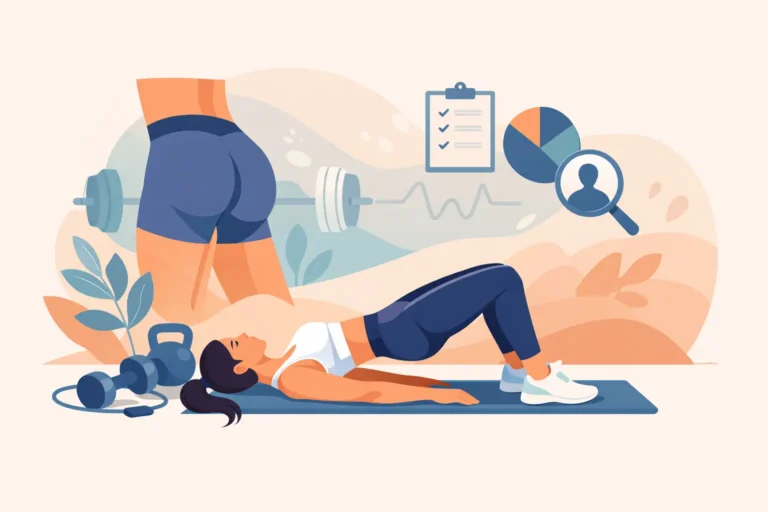
The glutes can work very hard even during a workout that leaves you feeling mostly in your thighs or lower back. This is usually not a problem of lack of motivation, but rather technique, exercise selection, and adding weight too quickly. The best exercises for the buttocks They don't rely on a single, trendy movement. They're a combination of conscious tension, appropriate range of motion, and regular increases in difficulty.
Strong glutes are important beyond aesthetics. They support pelvic stabilization, help with walking, running, and climbing stairs more efficiently, and relieve pressure on the lumbar spine. A well-planned workout can simultaneously build a firmer physique, improve posture, and provide greater comfort in everyday activities.
What makes an exercise really work the glutes?
The glutes aren't just one muscle. The gluteus maximus is primarily responsible for hip extension, a movement necessary for things like standing up from a chair or straightening up in a deadlift. The gluteus medius and minimus stabilize the pelvis and are more active in leg abduction movements and unilateral exercises.
Therefore, a plan based solely on squats won't be complete. Squats can be a great exercise, but for some people, they engage the front of the thigh more. Similarly, simply abducting the leg with a band won't provide the stimulus needed to effectively develop strength. The best results come from combining movements with a wide range of hip movement, unilateral exercises, and conscious muscle activation.
In practice, it also matters whether you can maintain a neutral spine position and pelvic control. If you overextend your lower back during movement, your body often "cheat", shifting the work from the buttocks on the back. This is a signal to reduce the load, shorten the range, or ask your trainer for corrections.
The best exercises for the buttocks in strength training
Hip thrust – a strong stimulus for the buttocks
Hip thrusting, or raising your hips while resting your upper back on a bench, places significant pressure on your glutes, especially at the end of the hip extension. Place your feet approximately hip-width apart. Pause briefly at the top, squeeze your glutes, and keep your ribs tucked in instead of pushing your chest up.
The most common mistake is lifting your hips too high. Don't try to achieve height at all costs. Stop the movement when your torso and thighs form a stable line, and your pelvis doesn't tilt forward. Beginners can start with a glute bridge on the floor, either without weights or with a band above your knees.
Romanian Deadlift - Glute Stretch
The Romanian deadlift teaches proper hip hinge. Your knees are slightly bent, the weight shifts close to your legs, and your hips move back. You should feel a distinct stretch in the back of your thighs and glutes, without any pull in your lower back.
This exercise rewards patience. A barbell, dumbbell, or kettlebell that's too heavy can quickly cause you to round your back or perform a momentum-based movement. Slowly lowering the weight for about three seconds often achieves more than adding weight.
Bulgarian Lunge – Strength, Balance and Stabilization
The Bulgarian lunge is challenging but very effective. The back leg rests on a platform, with most of the weight on the front leg. To engage the glute more, place the front foot a little further back and lean your torso slightly forward, maintaining a long spine.
The knee doesn't need to remain stationary over the ankle – it can move forward naturally, as long as the movement is stable and painless. The key is a controlled descent and a powerful push-off with the entire foot. If the exercise becomes too difficult, start with a backward lunge with one hand resting on a stable support.
Step-up – functional work of one leg
Stepping onto a platform is similar to an everyday movement, but when done consciously, it becomes a great glute exercise. Choose a box or step high enough to keep your pelvis level. Place your entire foot on the platform, transfer your weight onto it, and step onto it without pushing hard with the foot that remains on the floor.
Take your time on the descent. It's the control of the descent phase that builds knee and hip stability. Step-ups work well both without additional weights and with dumbbells held at your sides.
Leg abduction – a detail that improves pelvic control
Leg abduction on a cable machine, mini band, or machine won't replace strength training, but it's a valuable addition to your routine. It strengthens the gluteus medius muscles, which help maintain pelvic stability during walking, running, and single-leg exercises.
Perform the movement with less force than your ego dictates. Don't tilt your torso to the side or twist your pelvis to lift your leg higher. A dozen or so gentle, clean repetitions will be more effective than dozens of full-body movements.
Squat – effective when you adjust it to your needs
The squat doesn't have to be the main glute exercise, but it's definitely worth including in your routine. Depth, foot position, and body proportions all influence where you'll feel the most impact. Some people will find a goblet squat with a dumbbell in front more effective, while others will prefer a box squat, which facilitates depth and pelvic control.
If your back or knees hurt after squatting, don't automatically assume this exercise is off-limits. First, check your technique, jumping mobility, weight selection, and tempo. However, pain is a signal that shouldn't be ignored.
Pilates Reformer and Butt Training
Glute training doesn't always require a barbell. The Pilates Reformer allows you to precisely work on pelvic control, rib alignment, core stabilization, and smooth leg movement. Thanks to the spring resistance, you can safely build strength even when classic heavy-weight exercises are too demanding at a given stage.
This is a particularly good option for people returning to activity after a break, spending many hours in sitting position or feeling tension in the lumbar spine. The reformer isn't just an easier version of training, though. It's a precise tool that quickly shows whether you're leading the movement from your hips or compensating with your back.
At Velvet Gym, combining Reformer work with functional training can help you build not only the shape of your buttocks, but also improve the quality of movement in squats, lunges, and everyday activities.
How to create a plan that brings results?
For most people, a good starting point is two glute workouts per week, separated by at least one day off. You could start with hip thrusts and Romanian deadlifts in one workout, and Bulgarian lunges and step-ups in the other. Add one abduction exercise to each workout as a complement.
For main exercises, typically perform 3-4 sets of 6-12 reps. For accessory movements, a range of around 12-20 reps is best. You don't need to train to complete failure. Leaving 1-3 reps in reserve allows you to maintain technique and safely build up the load.
Progress can mean heavier weight, but also an extra repetition, a slower pace, a better range of motion, or less assistance from the other leg. Keep track of your results. Without it, it's easy to feel like your training is stagnating, even though your strength and control are actually improving.
It's not just training that determines the effect
Glutes need time to recover and material to rebuild. If your goal is to increase muscle mass, ensure you eat regularly with adequate protein, get enough sleep, and limit the chance of accidentally adding high-intensity cardio after every leg workout. If you want to reduce body fat, strength training is still a good idea – it helps preserve muscle and improves body proportions.
Don't compare your rate of change to social media results. Your body type, fitness level, activity history, and daily exercise routine will all result in individual responses. Instead of searching for the perfect exercise, look for a plan that you can perform consistently, pain-free, and with progressively better technique.
The best time to start won't come with a perfect plan. Start with a few well-executed movements, observe your body, and allow yourself to gradually build strength that will be visible not only in the mirror but also with every confident step.