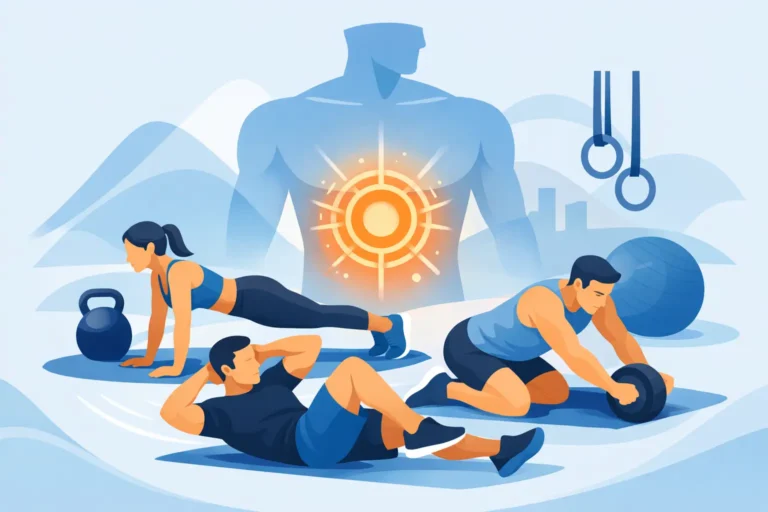
A strong core doesn't just mean visible abdominal muscles. It also means greater body control, a more stable posture, a more confident stride, and less tension in the lumbar spine. The best core exercises teach the torso to work with the hips, breathing, and shoulder blades—thus producing results that are felt not only during training but also during prolonged sitting, carrying groceries, or playing with a child.
What really strengthens core training?
The word "core" encompasses more than just the rectus abdominis. The deep abdominal muscles, pelvic floor muscles, diaphragm, back muscles, glutes, and hip muscles all contribute to its work. Their role isn't to constantly "burn" the abdominals with hundreds of contractions. They're meant to stabilize the spine and pelvis while the arms and legs move.
This is an important difference. Classic crunches can be a welcome addition for someone without symptoms, but performed quickly and without control, they often reinforce the habit of stretching the neck and rounding the lumbar spine. A better core plan emphasizes quality tension, calm breathing, and gradually increasing difficulty.
A well-executed workout can promote a slimmer physique, but it doesn't reduce localized fat. The visual effect also depends on overall activity, nutrition, sleep, and stress levels. The functional effect, on the other hand, better posture, greater strength and more efficient movements – usually occur faster when you exercise regularly.
The Best Core Exercises: 6 Moves You Should Know
The following exercises are effective because they teach you to maintain core stability in various positions. Start with two or three of them in one session. Perform the workout two or three times a week, allowing your body time to recover.
Dead bug – stabilization while lying down
Lie on your back, raise your legs so your knees are above your hips and your arms are pointing toward the ceiling. Exhale as you slowly lower the opposite arm and leg, keeping your lower back off the floor. Return to center and switch sides.
The dead bug is a great way to start if you want to experience core control. The idea is not to force your spine into the mat. Maintain a natural, slight curve and stop the movement if you lose stability. Perform 6-10 reps per side at a relaxed pace.
Bird dog – support control
Position yourself in a supported position: hands under your shoulders, knees under your hips. Extend one leg back and the opposite arm forward simultaneously. Your hips should remain as still as possible, without tilting to the side. Hold the position for 2-3 calm breaths, then switch sides.
This exercise is particularly good at showing whether the body can stabilize the torso while working the limbs. If lifting both the arm and leg at the same time is too difficult, start with just the leg or arm. Such a regression isn't a step backward—it's a conscious effort to build the right pattern.
Plank – a plank with good technique
Prop yourself up on your forearms and toes. Place your elbows under your shoulders, lengthen your neck, and slightly tuck your pelvis, as if you were trying to bring your ribs closer to your hips. Instead of fighting for a minute at all costs, hold the perfect position for 15-30 seconds.
The most common mistake in planking is dropping the lumbar spine or lifting the hips too high. In both cases, the exercise stops effectively developing stabilization. Three short, controlled sets are better than one long set performed at the expense of the spine.
Side plank – strength of the sides of the torso
The side plank strengthens the muscles responsible for pelvic stabilization and prevents the torso from tilting sideways. Rest your forearm on the floor, position your shoulder over your elbow, and lift your hips. Your body should form one long line from head to toe.
You can start by resting your lower knee on the mat. This is a great option for beginners, those who have just finished a workout, or those returning to exercise after back pain. Perform for 15-25 seconds per side and focus on breathing freely.
Pallof press – resistance to twisting
This exercise is performed with a resistance band or a pulley. Stand sideways to the anchor point, grasp the handle with both hands at your chest, and push your arms out in front of you. The band will try to rotate your torso, and your goal is to keep your ribs and hips still.
The Pallof press is incredibly valuable in functional training because in everyday life, we often need to resist unwanted twisting. Examples include carrying a bag in one hand or quickly changing direction. Choose a light resistance and perform 8-12 repetitions per side.
Glute bridge – core also starts in the hips
Lie on your back, bend your knees, and place your feet hip-width apart. Exhale as you lift your hips, squeezing your glutes without pushing your ribs up. Pause for a moment, then slowly return to the mat.
The hip bridge helps restore coordination between the glutes, pelvis, and core. It's especially helpful for those who spend long hours sitting. If you're feeling primarily in your lower back, reduce the height of the hip lift and ensure the movement begins with a gluteal contraction.
How to create an effective core workout in 20 minutes?
A simple session is enough to start: do 2-3 sets of deadlifts, bird dog, and glute bridge. Then add a plank or side plank. Rest 30-45 seconds between sets to regain your breathing and maintain technique for the next rep.
After a few weeks, you can increase the number of repetitions, lengthen the time under tension, or introduce exercises with resistance bands, dumbbells, and a cable pulley. However, don't increase everything at once. If you feel your abs and glutes working after your workout, but don't experience back pain or neck tension, that's a good sign.
It's also worth training your core with full-body movements. Squats, deadlifts, lunges, rows, and overhead presses all require a stable core. This is why strength and functional training yields such good, practical results when exercises are tailored to the individual's abilities.
Breathing and technique: the element that changes everything
During exercise, many people automatically hold their breath and tense their shoulders. However, your core works more effectively when you can breathe in a controlled manner. Take a slow inhale, drawing the air broadly towards your ribs, and during the more intense phase, exhale long and feel the gentle contraction in your lower abdomen.
Don't try to walk around with your stomach pulled in all day. Excessive, constant tension can restrict breathing and increase stiffness. The goal is to be able to consciously tense up when your body actually needs it.
If you have a recent injury, severe or radiating back pain, have undergone surgery, or are pregnant, selecting exercises requires an individual consultation. In such situations, a universal online plan cannot replace an assessment of your technique and current body capabilities.
Core on the reformer and in functional training
Pilates Reformer It allows for precise development of stabilization thanks to springs, a movable carriage, and controlled movement. It can be used to make the exercise easier for a beginner or to increase the challenge for someone who already knows their body well. However, the greatest value remains in paying attention to the positioning of the pelvis, ribs, and shoulder blades.
At Velvet Gym, core training is part of a broader approach to strength, mobility, and core health. Small groups, expert coaching, and visual guidance help you notice details that are difficult to capture during a quick, solo session. This is especially valuable when you want results without guessing whether the movement is being performed correctly.
The best time to start core training isn't with perfect form. It starts with a few conscious movements, consistency, and the decision that your body deserves the strength to make every day easier.