
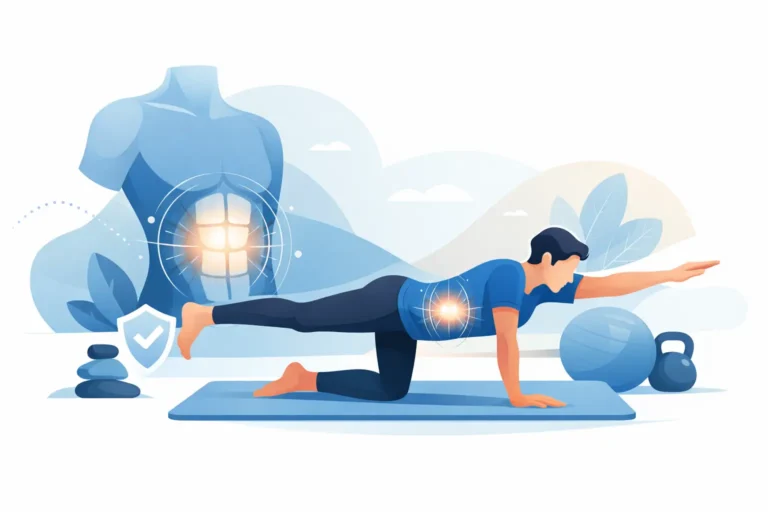
Lower back pain after prolonged sitting, a pelvic tilt during a squat, or tense shoulders after a simple grocery run often aren't caused by a lack of motivation. The body usually seeks stability wherever it finds it—a tense neck, locked hips, or overly tense back muscles. If you're wondering, how to improve trunk stabilization, start not with hundreds of sit-ups, but with learning to control movement, breathing and proper tension.
A stable core isn't meant to be stiff. It should provide you with secure support when lifting a child, deadlifting, climbing stairs, or twisting to reach something from the backseat of a car. This is the foundation for a more efficient workout, better posture, and greater comfort in everyday life.
What does core stabilization really mean?
Core stabilization is the ability to maintain a controlled spine and pelvic position during movement. It involves more than just the abdominal muscles. The diaphragm, pelvic floor muscles, deep back muscles, glutes, and the muscles around the hips are also important.
You can think of your core as a hub that transfers power between your legs and upper body. When this hub isn't controlling movement, energy "leaks." In a squat, your knees can fold inward, while running, your pelvis can drop to one side, and when lifting weights, you feel an unpleasant strain in your back.
So it's not about sucking your stomach in all day. Constantly tightening your muscles restricts free breathing and can increase tension. Good stabilization is flexible: the body can tense up when needed and then return to relaxation.
How to improve core stability: start with breathing
It may sound surprising, but breathing is one of the simplest ways to better control your core. The diaphragm works with the abdominal and pelvic floor muscles to create natural support for your core. If you breathe shallowly, primarily from the upper chest, your neck and shoulders often take on unnecessary work.
Lie on your back, bend your knees, and place your feet on the floor. Place one hand on your lower ribs and the other on your stomach. Inhale slowly through your nose, allowing your ribs to expand not only forward but also to the sides. On a long exhale, feel a slight stretch in your lower abdomen, as if zipping up tight pants. Don't force your lower back into the floor or hold your breath.
Do 5-8 of these breaths before a workout or after long hours at your desk. It's a small ritual that helps you reconnect with your body before moving on to more challenging exercises.
The positioning of the ribs and pelvis is important
The second step is to find a neutral, comfortable position. Your ribs shouldn't be jutting forward too much, and your pelvis shouldn't be constantly tucked in. Think of your chest as being above your pelvis, with your head comfortably aligned with your spine.
This position won't be identical for everyone. It might be different for someone with high joint mobility, different for someone who's had a pregnancy, or even different for someone who's had a back pain episode. Therefore, instead of copying a position from the internet, it's worth learning to feel which position allows you to breathe calmly and move without compensating.
Exercises that build control, not just fatigue
Initially, choose movements where you can easily spot any loss of position. The quality of the repetition is more important than the number of sets. If you find yourself clenching your jaw, raising your shoulders towards your ears, or feeling only your lower back, reduce the range, resistance, or tempo.
Dead bug – calm control while lying down
Lying on your back, raise your legs so that your hips and knees are bent at approximately a right angle. Point your arms toward the ceiling. Exhale and slowly lower the opposite arm and leg, just until your pelvis remains stable and your ribs don't rise. Return and switch sides.
This exercise teaches you to maintain a stable core as your limbs move. Do 2-3 sets of 5-8 repetitions per side. A smaller range is better than dropping your leg low to the floor in an impressive but uncontrolled manner.
Bird dog – stability in support
Position yourself on your hands and knees. Place your hands under your shoulders and your knees under your hips. Extend one leg back and the opposite arm in front of you. Don't twist your pelvis or sink between your shoulder blades. Imagine a glass of water resting on your lower back, and you don't want to spill it.
Hold the position for 3-5 calm breaths. Then switch sides. This exercise may seem simple, but it perfectly demonstrates the difference between swinging your limbs and consciously controlling your torso.
Side plank – support for the sides of the torso
The side plank strengthens the muscles responsible for, among other things, keeping the pelvis stable while walking and running. Start with the forearm and knee plank. Position your shoulder over your elbow, lift your hips, and align your body in one long line from head to knees.
Don't try to beat the record. 15-25 seconds will be enough if you can hold your breath and avoid sagging at the shoulders. Over time, you can lengthen the lever by straightening your legs.
Hip Bridge – Stabilization Also Starts in the Buttocks
Lie on your back, bend your knees, and place your feet hip-width apart. Exhale as you lift your hips, pressing your feet into the floor. Stop where you feel your glutes engage, but don't push your ribs out or arch your lower back excessively.
Strong glutes help stabilize the pelvis. This is especially valuable for people who spend a lot of time sitting, returning to activity after a break, or who feel their backs taking over the leg work during a workout.
Transfer stabilization to functional movement
Mat exercises are necessary, but the goal isn't a perfect plank. The goal is to move freely and confidently. So, once you've mastered the basics, incorporate stability into your squats, lunges, resistance band exercises, weightlifting, and strength training.
When squatting, inhale before the movement, and when rising, exhale and maintain a slight core tension. When lunging, check that your pelvis doesn't tilt sideways. When carrying a dumbbell in one hand, don't lean in the opposite direction – go slowly, breathe, and keep your ribs above your pelvis.
Unilateral exercises are particularly effective in functional training because they teach the body to respond to asymmetry. However, this doesn't mean everyone has to immediately train on one leg with heavy weights. You need to establish a stable technique first, then increase the challenge.
The most common mistakes that slow down results
The first mistake is training only the rectus abdominis muscles. Sit-ups may have their place in a training plan, but they alone won't teach pelvic and rib control during squats or walking. The second is progressing too quickly: a longer plank doesn't always mean better stability, especially when the hips drop and the lower back takes on the pressure.
Often the problem is also the neglect of the hips, feet and thoracic mobility. The body works as a whole. If the ankle is stiff and the hip isn't working well, the core may compensate with each squat. In this case, it's important not only to strengthen the core but also to address the source of the limitation.
Don't ignore pain radiating down your leg, numbness, weakness, or pain that worsens despite rest. In such cases, you should consult your training with a physiotherapist or doctor. Exercise should build fitness, not teach you to endure symptoms at all costs.
Regularity gives better results than one intense workout.
For most people this is enough 2-3 training sessions a week and a few minutes of mindful movement on other days. You can do breathing, deadlifts, and hip bridges in the morning, and focus on squat or lunge technique during your workout. This plan is realistic and allows the nervous system time to learn new patterns.
At Velvet Gym Pilates Reformer training and strength-functional training can support this process in two ways: you learn precision, breathing, and control, and then use them in strength-building movements. The intimate setting and observation of technique help you notice small compensations before they become ingrained habits.
Start with one exercise, performed with great mindfulness. Once your body feels that the movement can be both stable, powerful, and effortless, subsequent activities will simply become more enjoyable.