
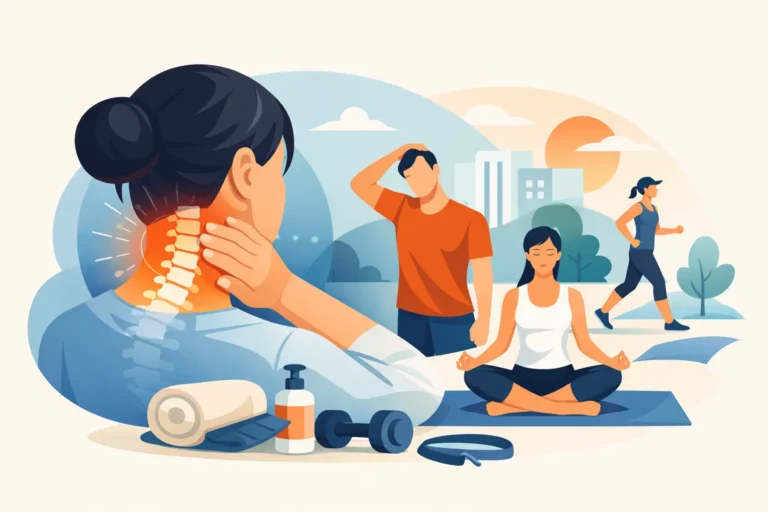
Neck pain often takes its toll after a long day at the computer, a long car ride, or a workout with tight shoulders. If you're wondering, how to reduce neck pain, don't look for one magic stretch. The best results usually come from a combination of temporary relief, gentle movement, improved body alignment, and working on habits that strain your neck daily.
Neck pain doesn't always indicate something serious, but it's not worth ignoring or forcing yourself to "sleep it away." The neck is part of a larger system: it's influenced by head position, chest mobility, shoulder tension, breathing, sleep, and the strength of the muscles that stabilize the shoulder blades and trunk. Therefore, an effective plan should be simple but consistent.
How to reduce neck pain when it appears suddenly?
If the pain appears after sleeping in an awkward position, working at a desk, or being under increased stress, start by reducing tissue irritation. For the first few days, avoid sudden head turns, intense neck rolling, or attempts to "extend" the neck. The characteristic crunching sound does not indicate that the problem has been resolved.
Heat can be helpful, especially if stiffness and a feeling of tense muscles are the dominant symptom. A warm shower or a hot water bottle applied for several minutes can provide noticeable relief. If the pain occurred immediately after the injury and is accompanied by swelling, a short cold compress may be more appropriate. In both cases, observe your body's reaction – the method is intended to reduce symptoms, not exacerbate them.
Don't completely give up exercise. Prolonged immobilization typically increases stiffness. Opt for short walks, gentle head movements within a pain-free range, and light activity that doesn't trigger symptoms. The rule is simple: your neck may feel tired after exercise, but the pain shouldn't significantly increase or persist the next day.
Find out what's really straining your neck
For many people, the problem doesn't start in the neck itself. A head pushed forward, arms raised while using a mouse, and a sunken chest cause the neck muscles to work almost constantly. The longer you maintain this position, the greater the risk of a feeling of heaviness, a burning sensation at the base of the skull, or limited head movement.
Position your screen at approximately eye level. Keep your keyboard and mouse close enough so you don't have to stretch your arms to reach them. Rest your feet firmly on the floor and your forearms on the desk or armrests. It's not about maintaining a perfect position for eight hours. The body likes change, so even the best position should be interrupted with a short movement every 30-60 minutes.
In practice, it's enough to stand up, walk a few dozen steps, take a few calm breaths, and move your shoulders. This is less spectacular than one long stretch in the evening, but often much more effective. The neck doesn't need to be constantly "held straight." It needs the ability to change position and appropriate muscular support.
Three safe exercises for a tense neck
Perform the exercises slowly, without jerking or experiencing sharp pain. Start with one set per day. If you feel improvement after a few days, you can perform them once or twice a day.
Chin Retraction Without Raising Your Head
Sit or stand straight, looking straight ahead. Gently tuck your chin back, as if to create a small double chin. Don't lower your head or tuck your chin into your chest. Hold the position for 3-5 seconds, relax, and repeat 8-10 times.
This exercise helps you regain control of your head position, especially if you spend many hours facing your laptop or phone. The movement should be subtle; pressing too hard will only increase the tension.
Shoulders down and slightly back
Stand comfortably, relax your jaw, and allow your shoulders to drop. Then, gently roll your shoulder blades down and slightly toward your spine, without sticking out your chest. Hold for 5 seconds and perform 8-12 repetitions.
The goal isn't to keep your shoulder blades rigidly pinched all day. It's about activating the muscles that relieve the upper shoulders and neck. If you feel any tension in your neck during the movement, reduce the range and check that you're not lifting your shoulders towards your ears.
Seated chest rotation
Sit firmly in a chair, cross your arms over your chest, and slowly twist your torso to one side. Keep your hips still. Return to center, then twist to the other side. Do 6-8 repetitions on each side.
When the chest is stiff, the neck often tries to compensate for the lack of movement. Improving mid-back mobility can therefore reduce neck strain without aggressively stretching the neck itself.
Stretching helps, but it's not always enough
Gentle stretching can provide a pleasant feeling of relief. You can tilt your head slightly to the side, keeping the opposite shoulder lowered, or perform gentle head tilts. However, don't force your head with your hand or do prolonged, painful head holds.
If the tightness returns daily, stretching alone likely won't solve the problem. Muscles may be overworked not because they're "too short," but because they're constantly working on weak shoulder blades, core, and chest. In that case, it's worth incorporating strengthening training, learning movement control and working on breathing.
Neck Pain Training: What Does the Body Need?
A well-designed workout doesn't rely on isolated neck exercises. It's more effective to work on the entire postural and movement pattern, which transfers load through the torso, shoulders, and hips. Exercises that strengthen the back muscles, stabilize the shoulder blades, deep abdominal muscles, and glutes are particularly valuable.
Pilates Reformer can be a good choice for those who want to build movement control in a safe environment and without accidental overload. Springs allow you to adjust the resistance, and the trainer's guidance helps you notice small habits like shoulder lifts or excessive neck tension. functional and strength training It works well when the goal is to increase the body's resistance to everyday stresses: carrying groceries, working at a desk, driving a car or having a more active weekend.
At Velvet Gym, training is conducted in small groups, with attention paid to technique and individual abilities. This is especially important if you suffer from recurring neck pain – you don't need heavier weights at all costs, just movements that allow the body to perform more confidently and freely.
Sleep, phone and stress – three underestimated factors
A pillow doesn't have to be perfect or expensive, but it should help keep your neck as neutral as possible. When sleeping on your side, make sure your head doesn't fall too far into the mattress or protrude too high. If you sleep on your back, a pillow that's too high can keep your neck in a flexed position for hours. Give yourself a few nights to assess the change, rather than replacing everything in one morning.
Your phone also matters. You don't have to stop using it, but raise the screen higher and take breaks. Looking down for long periods isn't just a matter of "bad posture," but also the amount of time you spend in one position.
Stress can increase tension in your jaw, shoulders, and neck. If you feel your arms automatically rising, pause for a moment. Lower your shoulders, relax your tongue and jaw, and take a few slow breaths with a prolonged exhalation. This is a small intervention, but it signals to your nervous system that it doesn't need to be constantly on alert.
When does neck pain require consultation?
Don't rely solely on exercise advice for diagnosis. Seek immediate medical attention if the pain appears after an accident or injury, is severe, or is accompanied by fever, severe headache, dizziness, blurred vision, or stiffness throughout the neck.
A visit to a doctor or physiotherapist is also necessary if pain radiates to the hand, numbness, tingling, weakened grip, or a significant loss of strength occurs. It's also worth seeking advice if symptoms don't improve after 1-2 weeks of gentle treatment or recur regularly despite changes in habits.
The best way to a lighter neck is consistency, not heroism. A few minutes of movement a day, a carefully chosen workout, and a technique tailored to your body can make more of a difference than a single, intense stretching session.