
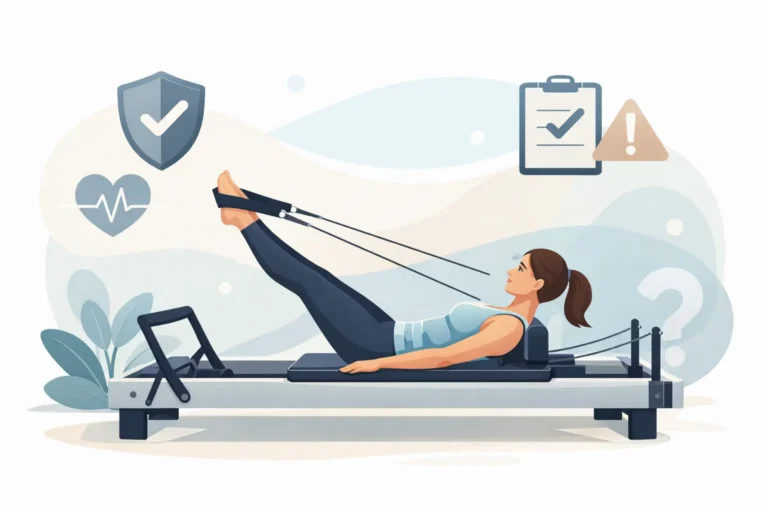
The biggest fears usually arise before stepping on a reformer for the first time. The machine, the springs, the moving cart – all of these can seem more complicated than a mat. Therefore, the question "is a Pilates reformer safe?" is not only valid, but simply sensible. The good news is that for most people, it's one of the safer forms of exercise – provided the exercises are well-chosen and technique is under control.
The reformer doesn't work by chance. It's a device that allows for very precise adjustments in resistance and range of motion. In practice, this means that training can be tailored to both a beginner, as well as someone who has had a long break, has a weakened core, tight hips, or a strained lumbar spine. This is why Pilates reformer is so often chosen by people who want to exercise intelligently, not just intensely.
Is Pilates reformer safe for beginners?
Yes, and it's often safer than unsupervised strength training. On a reformer, it's easier to position your body, feel the correct path of movement, and work without jerking. The springs provide resistance while also guiding the movement. This is a significant difference from exercises performed without any support, where the body easily compensates.
A beginner doesn't need to be in good shape, strong, or have experience. Instead, they need a gentle introduction, clear instructions, and technique corrections. Safety, therefore, comes not only from the machine itself, but also from the way the session is conducted. Small groups and a attentive trainer make a huge difference.
It's also worth remembering that the beginning isn't about creating flashy figures. A good Pilates reformer workout begins with the alignment of the pelvis, ribs, shoulder blades, and breathing. It's less dramatic, but this is where control is built, which protects the spine and joints.
What really determines safety on a reformer?
The equipment itself is neither "safe" nor "dangerous." Safety is determined by several specific factors. The first is the proper selection of exercises. A sedentary person works differently than someone who has just given birth, and yet differently still for a senior or an active person who wants to improve their mobility and strength.
The second element is the resistance setting. Too little resistance doesn't always help. Sometimes, it's harder to stabilize the movement and maintain control. Too much resistance isn't a good idea either, as the body begins to overcompensate with tension where it shouldn't. Well-selected springs make the movement smooth, demanding, and predictable.
The third element is tempo. Reformer Pilates doesn't reward rushing. When exercises are performed too quickly, it's easier to lose spinal alignment, block breathing, or shift work from the core muscles to the neck and shoulders. Slower, conscious movements are simply safer and more effective.
When does a reformer help your spine, and when should you be careful?
This is one of the greatest advantages of this method. Well-conducted training often relieves the spine, improves posture and strengthens muscles that are weakened in everyday life. Many people notice that after a few weeks, neck tension decreases, hip mobility improves, and it's easier to maintain an upright posture without feeling stiff.
But the key here is "well-guided." If someone has acute pain, a recent injury, a discopathy in the flare-up, or has just undergone surgery, the training plan needs to be modified. Not every exercise will be appropriate, even if it seems innocuous. Reformer Pilates can support recovery, but it shouldn't ignore the body's limitations.
That's why it's worth mentioning to your trainer any back pain, strain, dizziness, knee or wrist problems before your first session. This isn't about making excuses, but rather about smart training. The more your trainer knows, the better they can tailor the exercises to your body type.
Is Pilates reformer safe during pregnancy and after childbirth?
It depends on the stage, your well-being, and the consent of your doctor or physiotherapist. For many women, the reformer is a great tool for safely working on breathing, stabilization, mobility, and spine comfort. At the same time, pregnancy is a time when you don't exercise "as usual, just lighter." What really matters here is the right position, range of motion, and load.
After giving birth, a reformer can also be a great support, especially for regaining core control, working the pelvic floor, and improving posture. But again, don't just pick up any exercise set you find online. The postpartum body needs precision, not pressure. Sometimes less is more, especially in the beginning.
The most common mistakes that reduce security
Most problems don't stem from the method itself, but from overestimating one's abilities. Someone who tries to immediately do a more difficult version of the movement speeds up, loses their breath, and instead of strengthening the body, begins to overwork it. The reformer looks light, but it can very honestly demonstrate lack of stability.
The second common mistake is exercising through pain that doesn't feel like regular muscular exertion. If you experience a stabbing pain in your spine, a pulling sensation in a joint, or a feeling of instability, it's a sign to stop and adjust. Pilates isn't about gritting your teeth. It's meant to improve the quality of movement, not destroy it.
The third issue is a lack of concentration. This is a training session that requires presence. When the body is working on a moving cart and the mind is elsewhere, it's easier to be imprecise. Good technique doesn't have to be perfect, but it does need to be conscious.
How to recognize that classes are being conducted safely
Firstly, the trainer asks questions about health, well-being, and previous experience. Secondly, it explains not only what to do, but also why and what to pay attention to. Thirdly, it corrects the positioning, rather than limiting itself to general motivation. If no one in the gym is paying attention to technique, it's difficult to talk about truly safe training.
The organization of classes is also crucial. Small groups make it easier to monitor each participant and react quickly if something needs to be changed. That's why, in places focused on quality movement, like Velvet Gym, safety isn't an afterthought, but its foundation. Technology can support exercise control, but it's the attentive trainer who truly makes it happen.
For whom a reformer may not be the best choice to start with?
There are situations where it's better to start with a private consultation or a more relaxed approach. This is especially true for people with acute pain, recent injuries, post-operative conditions, or neurological issues requiring special supervision. This doesn't mean the reformer is out of the question forever. It often just means you need to start differently.
A similar situation occurs with people who haven't exercised for a long time and have a significant fear of movement. For them, safety isn't just about training parameters, but also about psychological comfort. In such cases, it's best to enter the method calmly, without pressure or comparing yourself to others.
What gives you a sense of security after the first class
Most often, it's not about the workout being easy. It's about the body feeling "put together" after the session, not broken down. Your back feels lighter, your movement is more relaxed, and your muscles work without feeling strained. This is a very good sign.
This is precisely the power of the reformer – you can feel the intense, focused work, and at the same time leave the gym feeling more comfortable than when you walked in. For many people, this is the first workout after which they don't need to "recover" and just want to come back for another session.
So if you're wondering whether Pilates reformer is safe, the answer is yes, when the training is tailored to you, guided by mindfulness, and based on technique rather than showmanship. It's one of those methods that teaches the body to cooperate rather than fight against its own limitations. That's why it's so effective when you care not only about your figure but also about healthy movement, a strong core, and greater comfort in everyday life.