Not everyone needs a noisy gym, long lines for equipment, and a "eyeball" workout. Small training groups are especially beneficial if you prioritize quality movement, safe progression, and the kind of support you'd expect in a crowded gym. This format is for those who want to exercise effectively without feeling like they have to keep up with the random pace of the entire gym.
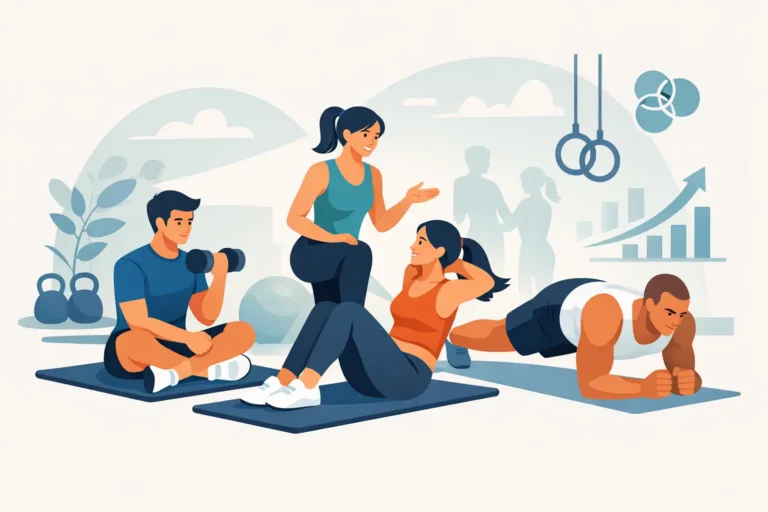
In a small group, the trainer sees more. He notices when the knee rolls inward during a squat, when the shoulders take over, or when the movement on the reformer becomes too fast. Such corrections often take a few seconds, but they can transform the comfort of the exercise, the safety, and the overall results of the entire plan.
Small training groups – benefits for technique
Good technique isn't just a bonus for advanced users. It's a starting point, whether you're returning to movement after a break, wanting to reduce back strain, or building strength and physique. In a large group, the instructor typically leads the energy of the class and maintains the overall rhythm. In a small group, they can simultaneously lead the class and observe the participants.
This is especially important in strength and functional training. The weight itself doesn't produce the desired effect—it's how the body moves it that counts. Correct foot position, a stable core, shoulder blade control, and a well-balanced range of motion ensure that the right muscles are engaged and joints aren't unnecessarily overloaded.
The Pilates Reformer works similarly. Springs create resistance that can be precisely adjusted, but the equipment doesn't do the work for you. The trainer helps you align your pelvis, ribs, and breathing, then selects an exercise variation to suit. Your mobility and the goal. This allows training to strengthen the core, improve posture, and build control, rather than perpetuate compensations.
Correction immediately, not after a few weeks
A small group allows for feedback during the movement. You won't have to wonder later why your neck feels more than your abs after a workout, or why a squat strains your knees. The trainer can simplify the exercise, change your position, reduce the load, or suggest a different range.
This doesn't mean that every movement has to look identical. Everyone's body varies in structure, injury history, mobility level, and current form. Good coaching is about finding a safe version of an exercise for a specific individual, not forcing them to copy someone else on the mat.
Effective without accidental overload
Many people give up on exercise not because they lack motivation, but because the workout they chose proved too difficult, too chaotic, or simply not appropriate. Small groups allow for better intensity management. One person can perform a basic version, another increase the resistance, and a third work on a higher range—all within the same portion of the class.
This model is also beneficial for those who want to return to activity after a long break. You don't have to start with maximum effort to feel progress. Regular training with a well-balanced difficulty improves strength, fitness, stability, and confidence. Over time, it becomes easier to climb stairs, lift groceries, run after your child, or spend the day at your desk without increasing back discomfort.
At Velvet Gym, visual exercise guidance technology supports this process, not replaces the trainer. Screens help maintain the structure of the workout and understand the next steps. This gives the trainer more space to focus on what no manual can show: quality of execution, breathing, body positioning, and proper load.
Measurable progress comes in many forms
Results don't always start with a number on the scale. Sometimes the first sign is a more relaxed bend, a more stable position on a support, or the absence of pain after a long day of sitting. For one person, progress means increased strength, for another, a slimmer physique, and for yet another, regaining confidence in their own body.
In a small group, the trainer can more easily detect these changes and know when it's worth adding resistance and when it's more sensible to reinforce the basics. This is more important than rapidly increasing the weight just because everyone else is doing it.
Motivation that is not based on pressure
Small-scale classes also have a psychological dimension. You're entering a space where the trainer knows your abilities, and the group isn't an anonymous crowd. It's easier to ask about an exercise, share a bad day, or mention that your lower back is bothering you. This kind of communication allows you to exercise responsibly, instead of pretending everything is fine.
Consistency often comes from comfort. When you know your training has a clear plan, you don't have to fight for equipment, and you're not afraid of being judged, it's easier to come back. Over time, classes become a regular part of your week, not just another ambitious decision postponed until Monday.
A small group can also be positively motivating. You see others working towards their own goals, but you don't have to compare yourself to them. There's a shared energy, without competing over pace, weight, or the perfect post-workout photo. For many people, this is the most lasting form of motivation.
Who does this format work best for?
Small groups are a good choice for beginners because they provide step-by-step guidance. They also work well for more experienced individuals who don't want to follow a routine and want to refine their movements.
This format is especially worth considering if you experience recurring back tension, have a sedentary job, are returning after a break, or want to strength train without guessing whether you're doing the exercises correctly. Pilates Reformer It can be a good option when you need greater mobility, stability, and conscious bodywork. Strength and functional training is a good option when strength, fitness, and agility in everyday life are priorities.
However, this isn't a solution for everyone in every situation. If your primary goal is highly specialized sports training, rehabilitation after a recent injury, or working on a particularly complex movement problem, individual training and consultation with a qualified specialist may be a better place to start. A small group provides significant attention, but it doesn't replace medical diagnosis and therapy when needed.
How to Get the Most Out of a Small Group
Arrive a few minutes early and let the trainer know if you're sore, have limited movement, or are recovering from an injury. This shouldn't be a hindrance to your workout—it's valuable information that helps you choose the right exercise option. It's also important to communicate your goals: improving your posture, strengthening your glutes, reducing neck tension, or building your fitness.
During classes, don't race against the pace of others. If the trainer suggests an easier version, don't treat it as a step back. Often, a controlled, basic version allows you to more quickly build the stability necessary for later progress.
Consistency makes the biggest difference. Two or three well-thought-out workouts a week, performed with good technique, will usually yield better results than one high-intensity burst every few weeks. Choose workouts that leave you feeling your body working, but also energized to return for the next one.
If you're looking for a workout that supports physique, strength, and a healthy core without the anonymity of a large gym, start by examining how you respond to mindful movement. A good workout isn't meant to make you barely get through an hour. It's meant to make you feel like your body is working with increasing confidence, efficiency, and support.