
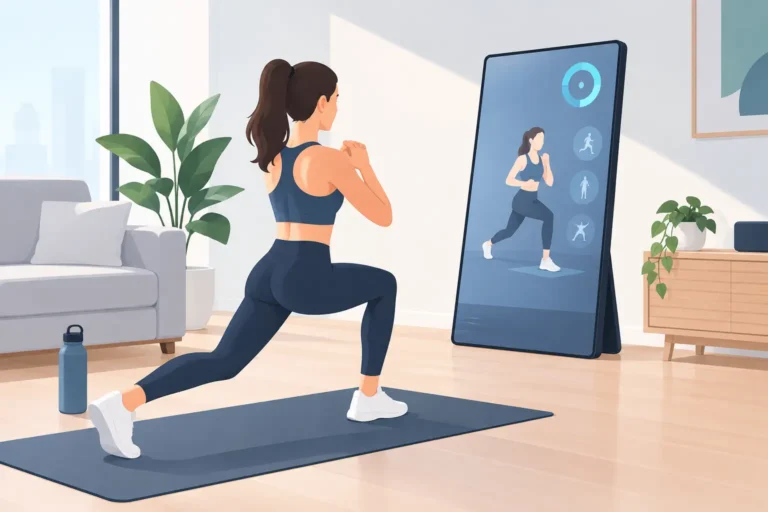
The screen shows the next exercise, the number of repetitions, and the pace. You don't have to think about what to do next—you can focus on what really makes a difference in the quality of your workout: breathing, body positioning, and movement control. That's why it's important to know, how to exercise on smart screens, so that technology supports your results, not just counts down the time.
Intelligent training isn't about copying movements from a video. It's a visually guided workout where the screen organizes the plan, and you complete it at your own pace and at a level appropriate to your current fitness level. When used properly, it helps build strength, improve fitness, strengthen core muscles, and take care of your spine without the chaos of a large, crowded gym.
What does training with a smart screen change?
The biggest advantage is a clear plan. You can see what exercise you're doing, how many sets you have left, and when it's time to rest. You don't waste energy searching for free equipment, analyzing random schedules, or guessing what to do after squats.
The screen guides you through the sequence but doesn't impose a single solution on everyone. This is a significant difference. Someone new to training can choose a more relaxed option and lower load. Someone more advanced can increase resistance, pace, or the number of repetitions while maintaining the same movement logic.
At Nano Gym, technology motion imaging It provides added value: it helps you notice details that are difficult to spot during a solo workout. Are your knees stable? Does your back remain neutral? Are your shoulders not rolling toward your ears? These small details determine whether an exercise strengthens your body or merely fatigues it.
How to exercise on smart screens step by step
Start with your goal, not the first available position
Before starting your workout, answer one simple question: what do I need today? If after many hours at your desk, you feel back tension, choose a session that strengthens your core, glutes, and upper back. If you're looking to improve your physique and strength, focus on a full-body workout with a carefully selected load. After an intense week, mobility and a more relaxed functional workout may be a better choice.
A goal doesn't have to be ambitious to be worthwhile. A regular, 30-minute workout, done well, usually yields more than a long session done without focus and with too much weight.
Watch the move before you do it
Don't treat the on-screen instructions like an advertisement to be fast-forwarded through. Take a moment to observe: where the movement begins, how your feet are positioned, which direction your knees are moving, when you exhale. Only then do you set up for the exercise.
When squatting, make sure your body weight is evenly distributed across your feet. When rowing, first align your shoulder blades, and only then pull the handles. When doing abdominal exercises, don't pull your head with your arms—the work should be initiated by your core and a calm exhale. The screen displays a pattern, and your task is to translate it to your own body without rushing.
Choose a variant that allows you to maintain your technique
The best weight isn't the one that looks impressive. It's the one that requires effort on the last reps, but you can still maintain a stable core, full control, and even breathing.
If you lose balance during lunges, shorten your range of motion or perform a simpler variation. If your shoulders collapse during push-ups, switch to an easier position. This isn't about falling back, but rather consciously building a base. Strength develops when the body is challenged to its capabilities.
Keep pace instead of chasing the clock
Smart screens help maintain rhythm, but the number of repetitions isn't the only goal. In strength and functional training, a slower lowering phase often provides better control than a frantic acceleration. In stabilization exercises, a few seconds of quality tension can be more effective than a dozen sloppy movements.
Breathe naturally. Exhaling most often accompanies the exertion phase, such as rising from a squat or pressing a weight. Inhale as you return. Don't hold your breath, especially when learning new movement patterns.
Technology leads, coach adjusts
A screen is a great way to organize your training, but it's no substitute for careful assessment. Every body has a different story: limited hip mobility, a tight neck, a knee injury, postpartum, or simply a day with less energy. Therefore, in a small club, the combination of technology and a trainer's presence is paramount.
A trainer can correct foot positioning, adjust the weight, suggest a safer exercise, and explain the cause of any discomfort. This way, you don't have to force your body to conform to the screen. The training plan adapts to you.
At Velvet Gym, the screen helps you organize your work, allowing your trainer to focus on your technique, safety, and movement quality. This is especially important for beginners, those returning to exercise, and those who want to exercise independently without feeling lost.
When to slow down or change an exercise?
Muscle burning at the end of a set and rapid breathing are natural responses to exertion. Sharp, stabbing pain in a joint, numbness, dizziness, or radiating pain are not signs that you need to "train." If this happens, stop the exercise and seek help.
It's also worth slowing down when your technique is noticeably breaking down. A rounded back during a deadlift, knees giving way during a squat, or a tense neck during abdominal exercises are all signs that you need to reduce the load, shorten the range, or take a longer rest. Smart modifications build progress. Ignoring your body's signals most often delays it.
An example of a well-organized screen session
A solo workout can last 35-45 minutes and doesn't require randomly combining everything. Start with a few minutes of gentle warm-up: walking, hip mobilization, shoulder circles, and glute activation. Your body should be ready to move, not just warmed up to the point of breaking into a sweat.
Then, perform a strength block with full-body exercises like squats, pulls, presses, and hip hinges. Choose a weight that feels challenging on the last two or three reps. Between sets, use the time to catch your breath, not to mindlessly scroll through your phone.
Finally, add a short stabilization and mobility block. A tailored plank, anti-rotation exercises, and chest and hip relaxation can round out the session nicely. If your primary goal is a healthy spine, this section isn't an add-on—it's an integral part of your workout.
How to build results week by week?
Don't change your plan every time you enter the gym. Give your body time to learn the movement. For two or three weeks, you can repeat similar patterns, gradually increasing the number of repetitions, load, or tempo control. This will make it easier to see real progress: a more stable squat, a stronger back, improved posture, and less fatigue during everyday activities.
For most people, two or three workouts a week are a good starting point. If you already have a regular practice, Pilates Reformer, intelligent strength and functional training can be a great complement. Pilates develops control, mobility, and body awareness, while strength training helps utilize this control in more demanding movements.
The best workout on a smart screen is one that leaves you feeling satisfied, not requiring days of recovery. Choose quality, ask for guidance, and give yourself space to learn. Every well-executed set is an investment in a fitter, stronger, and more confident body.